
Explore stunning vintage ornament and pattern art from Owen Jones’s The Grammar of Ornament, a 19th-century design masterpiece that gathers ornamental styles, prints, and decorative art motifs from around the world. A treasure trove for anyone into wallpaper inspiration, textile design, interior décor, and historical patterns.
Below is a curated collection of some of the best plates from Owen Jones’ Grammar of Ornament. The Grammar of Ornament was a seminal design sourcebook by the British architect.
First published in 1856, the book is still an essential publication today. An interior textile designer friend who has worked for many famous brands has a modern edition of this book. When she was studying her art, it was one of their texts.
I have already featured a collection of Owen’s Chinese Ornamental patterns. The patterns and designs in the Grammar of Ornament are more historically and geographically diverse.
The book explores the architecture, textiles, and decorative arts of 19 different cultures and periods, from Egyptian to Italian, from Renaissance to Elizabethan design. The final chapter focuses on the glory of nature and acknowledges the significance of the form found in nature on design.
Who was Owen Jones
Owen Jones was an English-born Welsh architect. He was a versatile architect and designer and one of the nineteenth century’s most influential design theorists. Owen pioneered modern colour theory, and his ideas on flat patterning and ornament remain relevant today.
As a young man, Owen embarked on a grand tour of Europe. He visited many ancient cities in Italy, Greece, Egypt, Spain, and Turkey.
Owen studied the examples of architectural polychromy (architecture decorated in various colours) in these cities. His travels would have formed a foundation for his design theories, which he honed over the years through lectures. Before publishing it all in his most important book, “The Grammar of Ornament“.
The publication, in itself, was groundbreaking at the time for its beautiful colour plates. Owen funded the project himself. To achieve excellent colours, he turned to the new and expensive technique of chromolithography. (The same method used for the fabulous Educational Geography Posters by Yaggy).
Owen Jones’ Grammar Of Ornament Prints
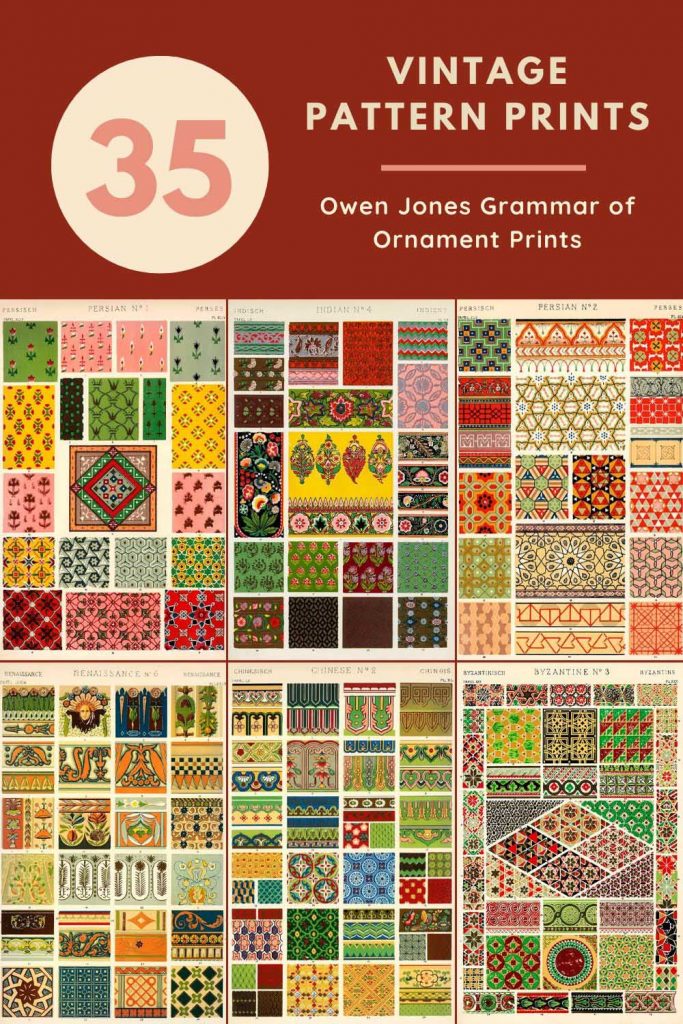
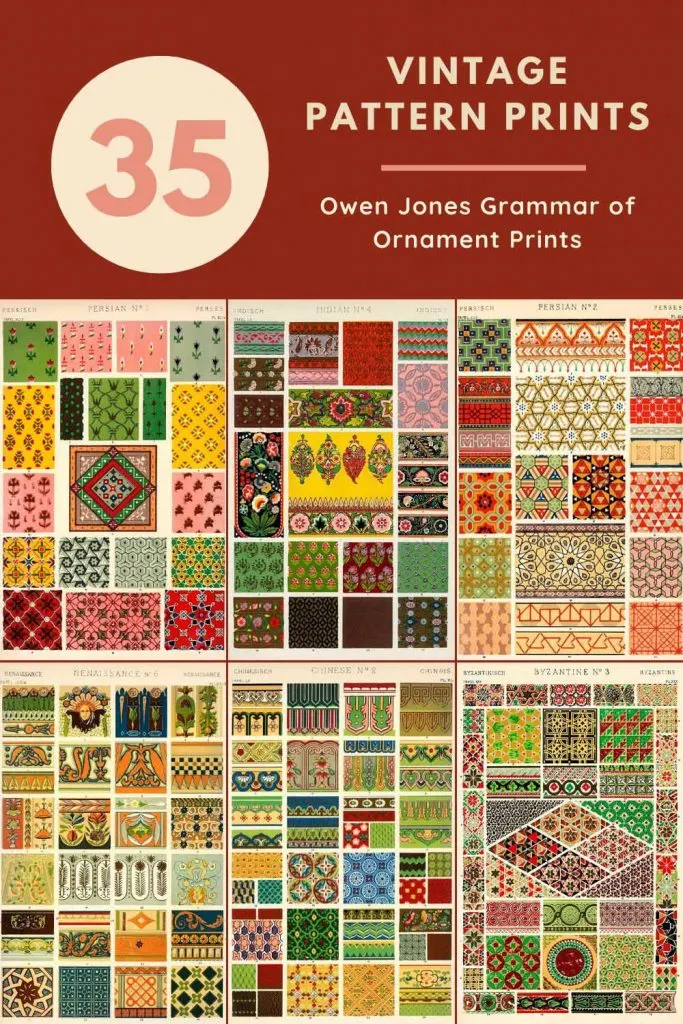
There are over a hundred colourful prints in the book; I have carefully selected about a third of them here. I have chosen some of the brightest and most exciting plates covering a range of design cultures and eras.
To see the full collection of plates, you can access the book at the Smithsonian Digital Library.
If you click on the title of the Owen Jones Grammar of Ornament print that you want, a larger image will open in a new tab in your browser. Right-click the image and save it to your hard drive.
The images can be printed at home or sent to an online print shop for larger images on quality paper.
Egyptian Grammar Of Ornament
Owen starts his chapter on Egyptian grammar by describing it: “The Architecture of Egypt has the peculiarity over all other styles, that the more ancient the monument, the more perfect is the art.“
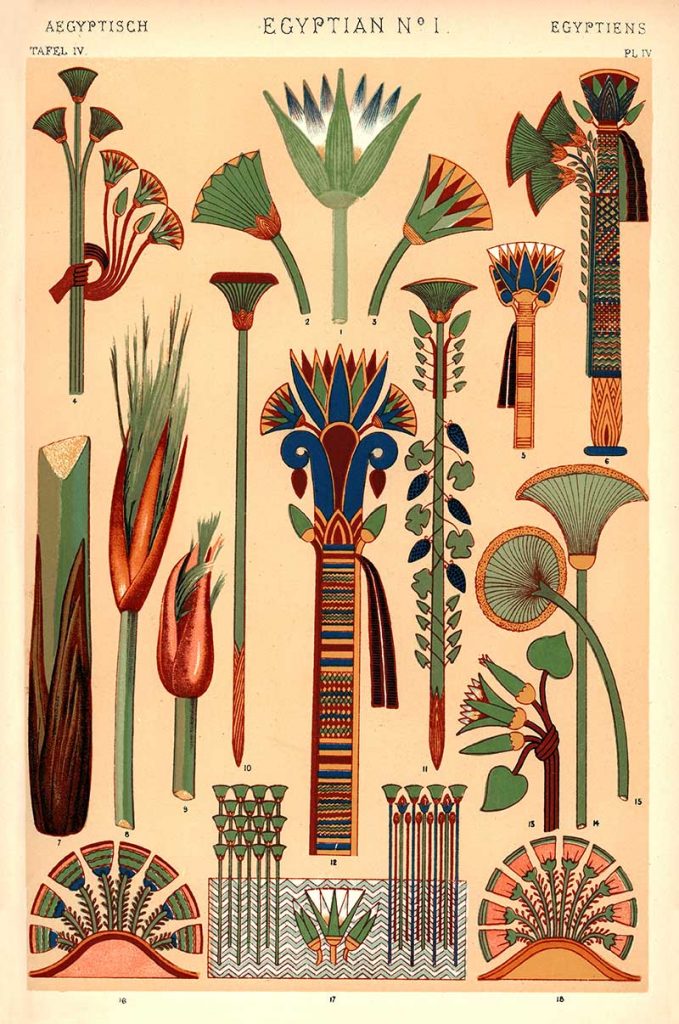
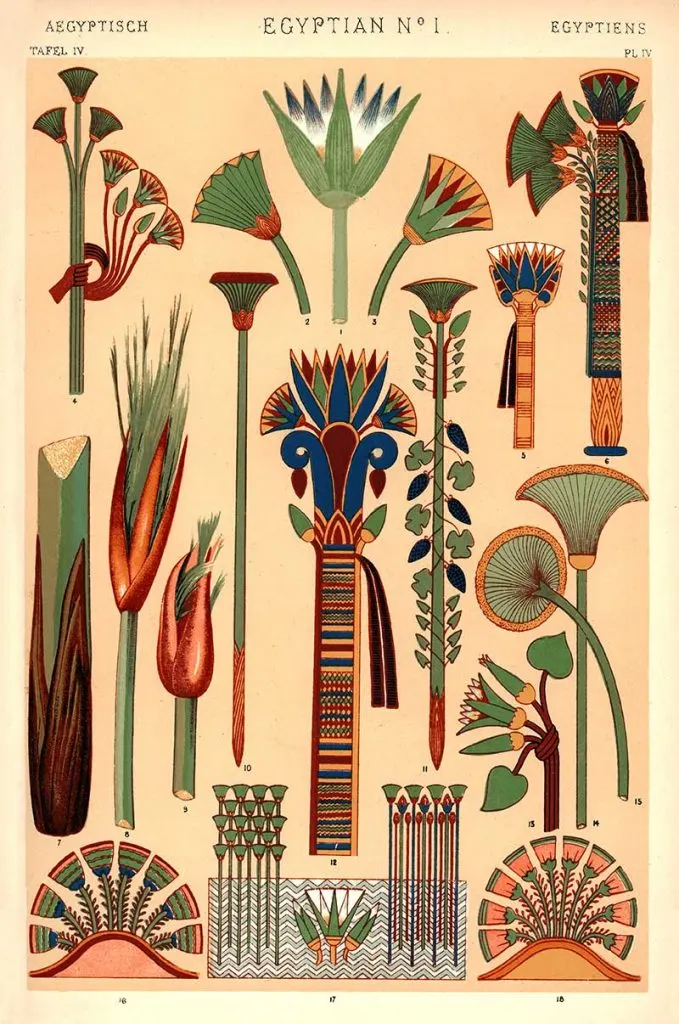
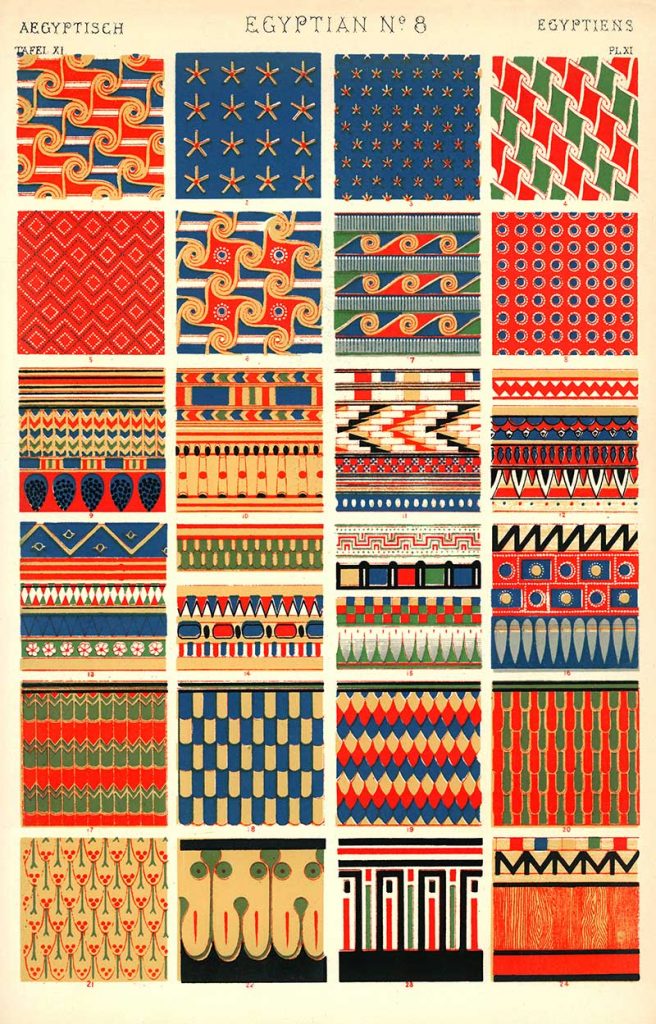
I have selected four ornament plates from the Egyptian chapter in the Grammar of Ornament.
In the Grammar of Ornament, Owen describes these as constructive ornaments based on the columns at the temples of Luxor and Karnak. The columns are designed around the papyrus plant.
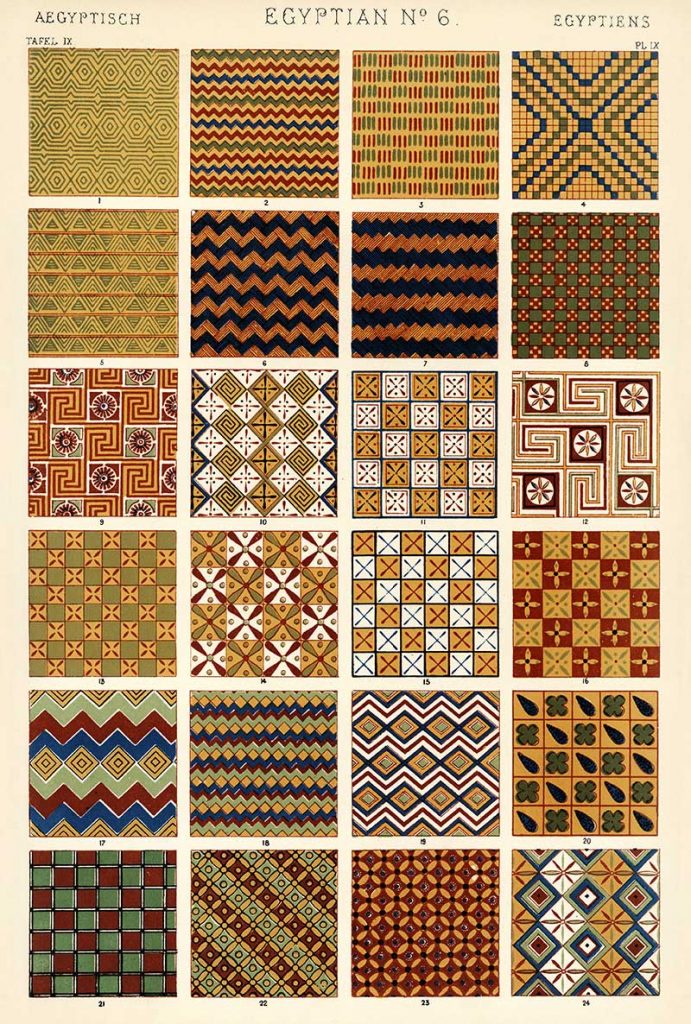
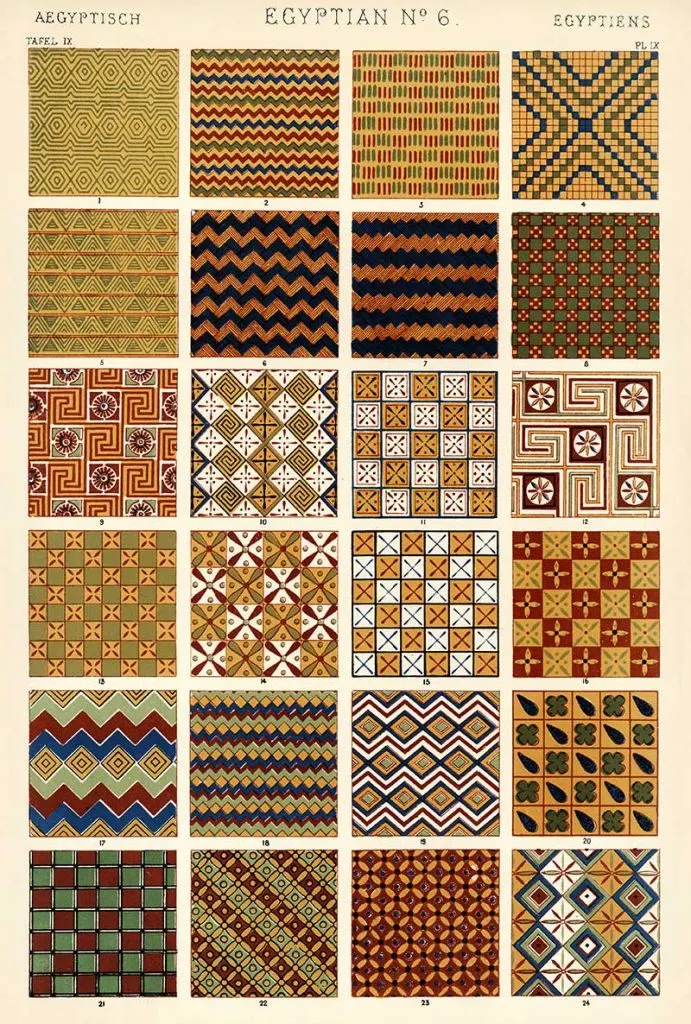
The ornaments on this plate are taken from paintings on tombs in various parts of Egypt, as well as from original drawings. These woven patterns can be produced on a loom.
Some of the patterns on this print are based on drawings of paintings on Mummy cases in the Louvre, Paris.
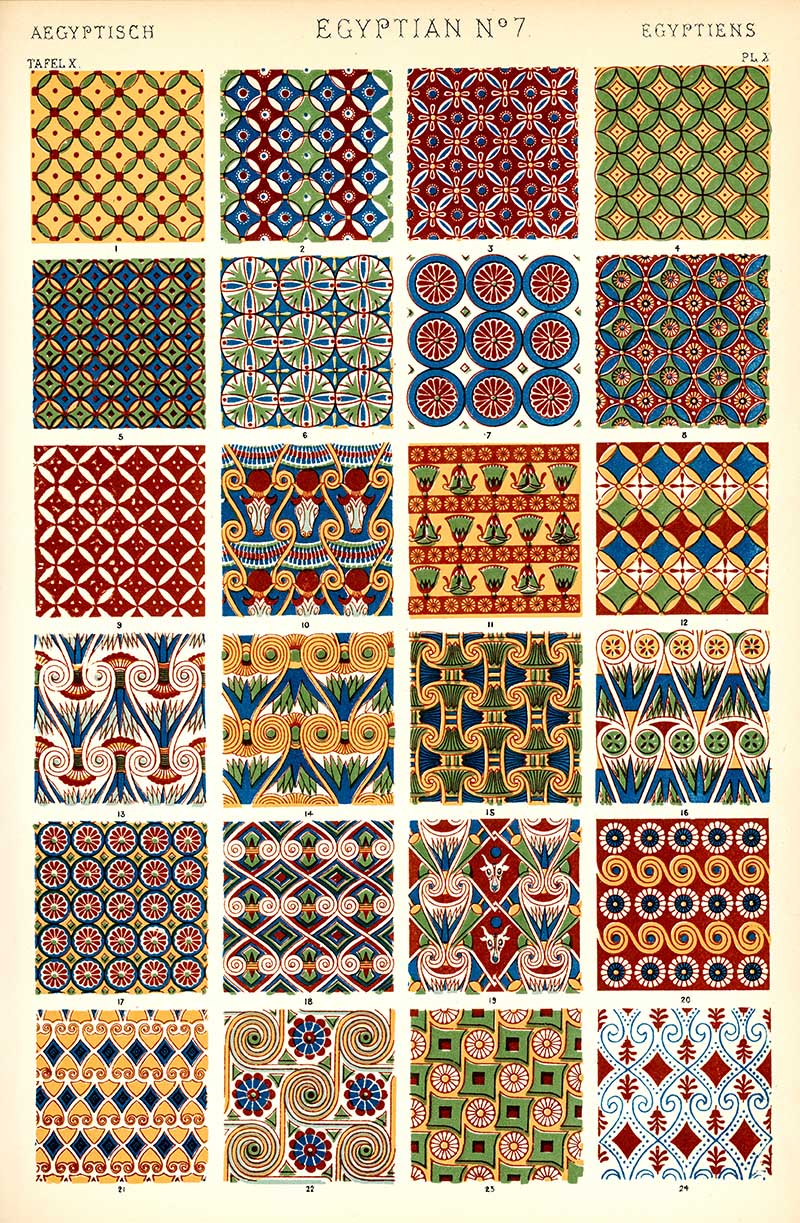
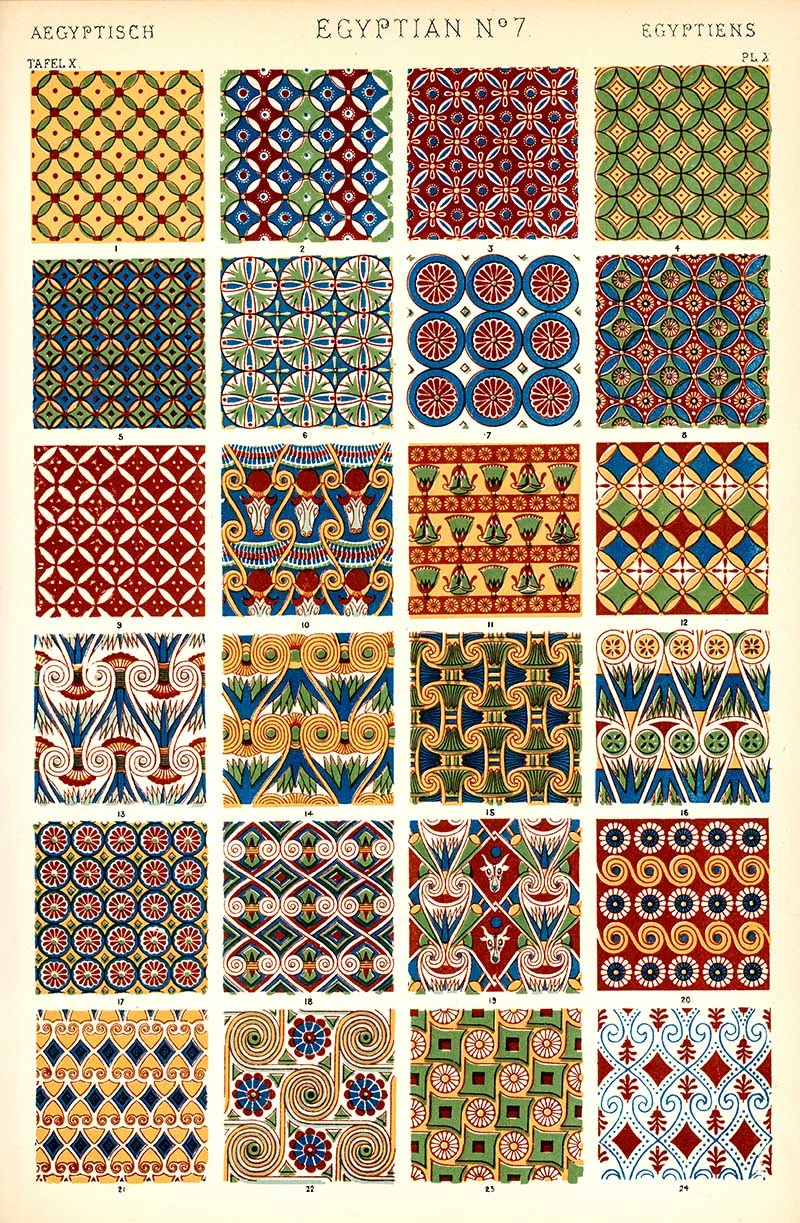
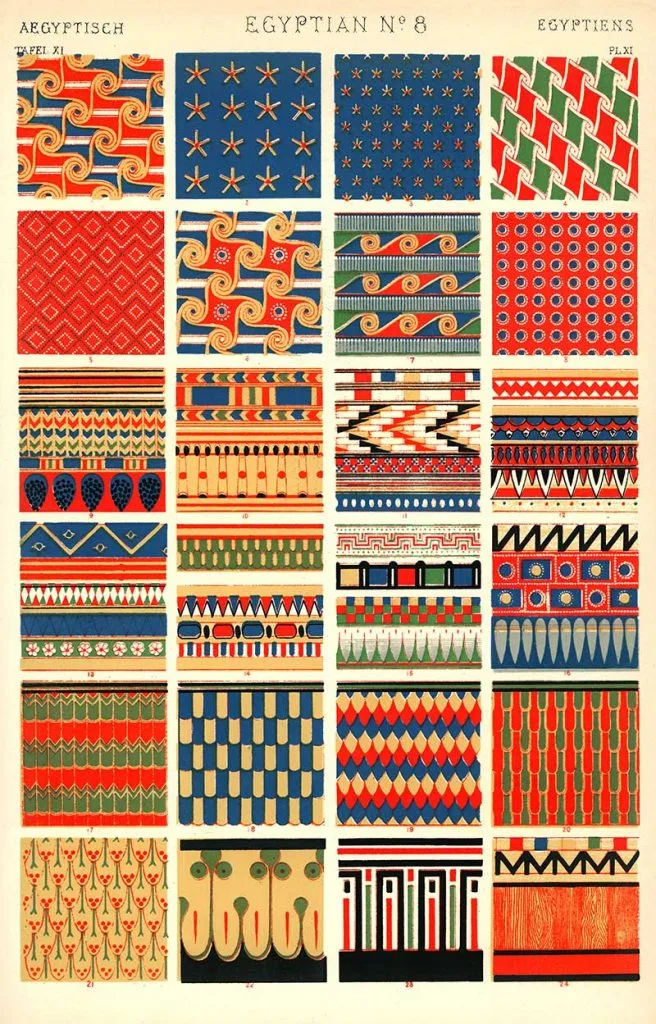
These plates are based on the Tombs at Thebes and Mummy cases and robe fragments in the Louvre, which are the most colourful Egyptian ornament plates.
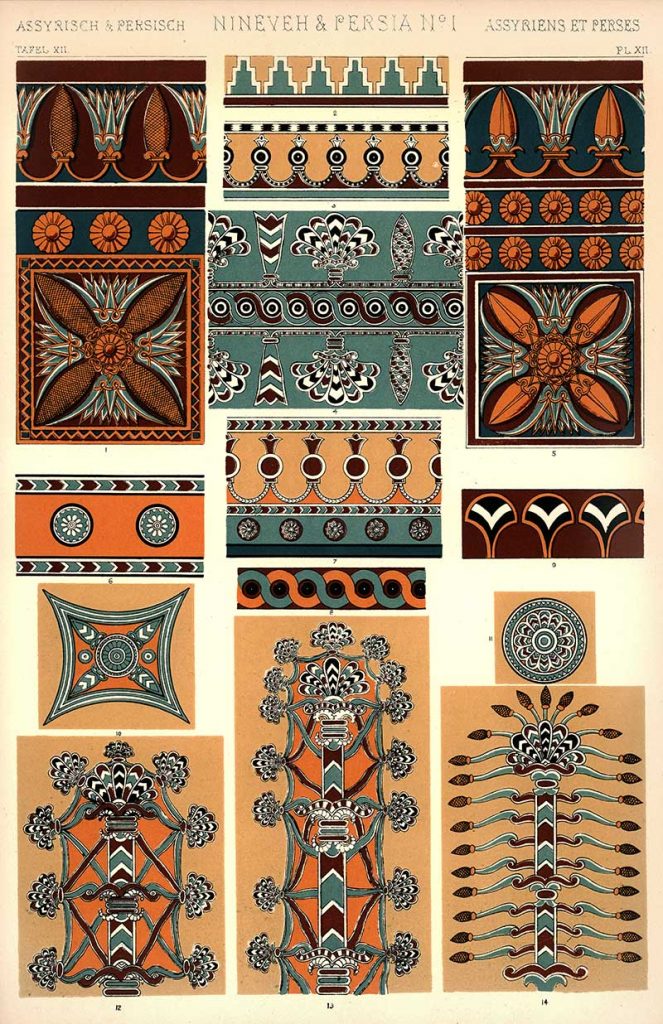
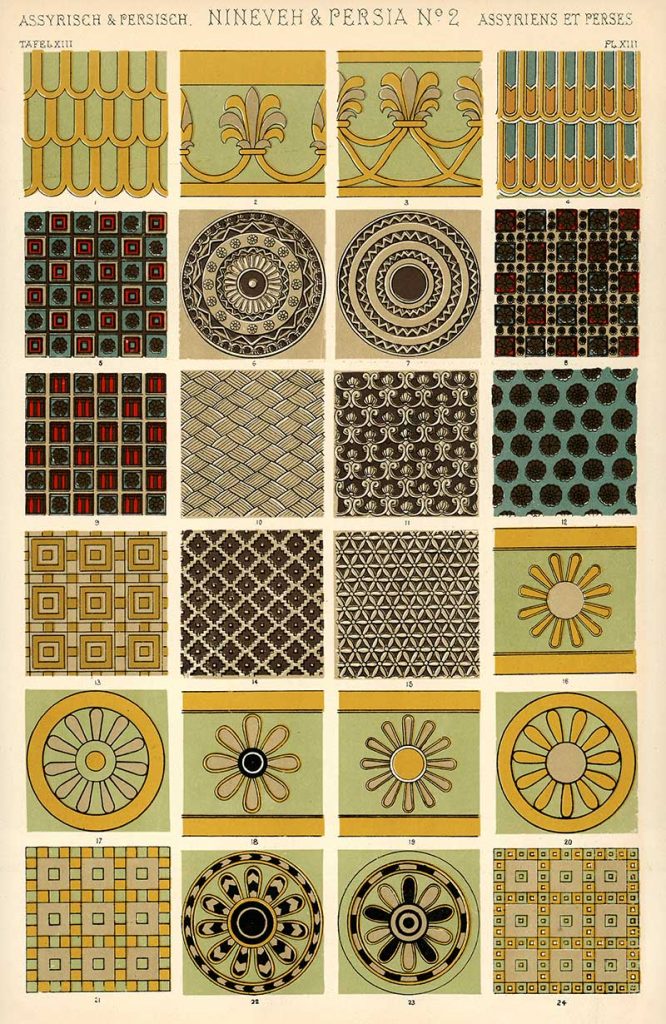
Assyrian And Persian Ornament
Owen describes Assyrian art as borrowed from the Egyptian style and then modified by the Assyrians’ religious and cultural differences.
Nineveh was an ancient Assyrian city of Upper Mesopotamia, located on the outskirts of Mosul in modern-day northern Iraq. For 50 years, it was the largest city in the world.
The ornaments on this plate were taken from The Monuments Of Nineveh by Austen Layard (1849).
Greek Grammar of Ornament
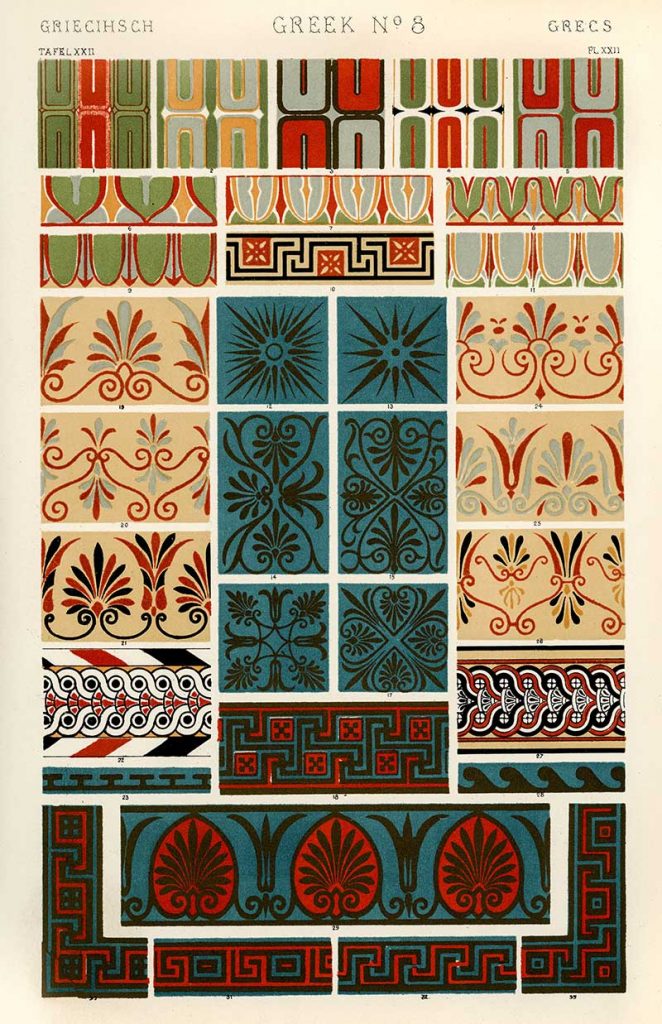
Owen describes Greek art as partly borrowed from Egyptian and partly from Assyrian art. However, it has developed in a new direction, but unlike those genres, it is not restrained by religious laws.
The patterns on the Greek plates 3, 4 & 5 are from Greek and Etruscan Vases in the British Museum and the Louvre.
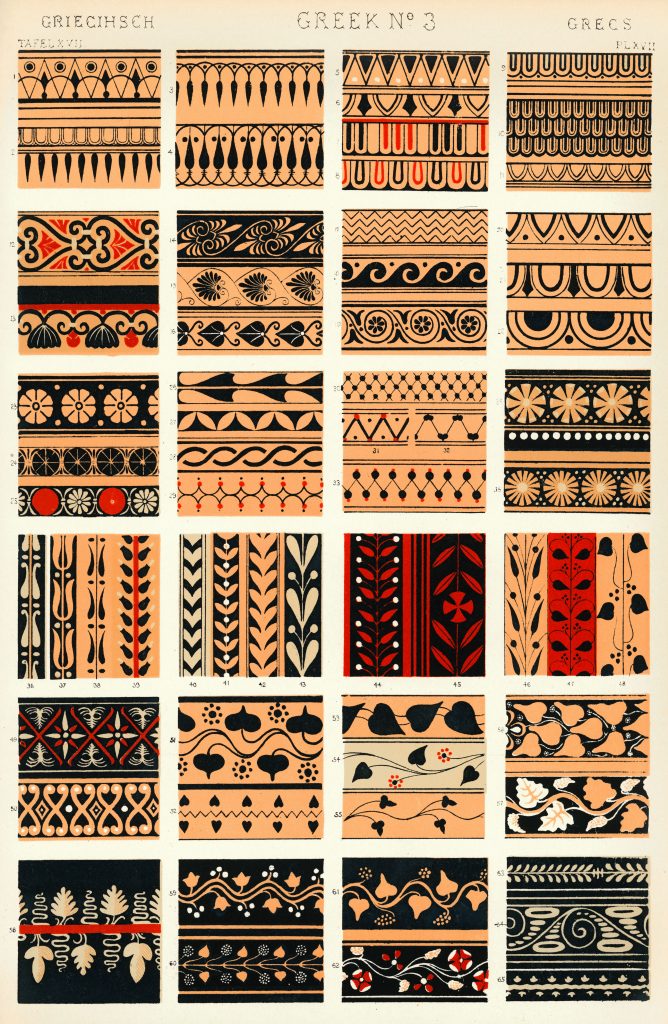
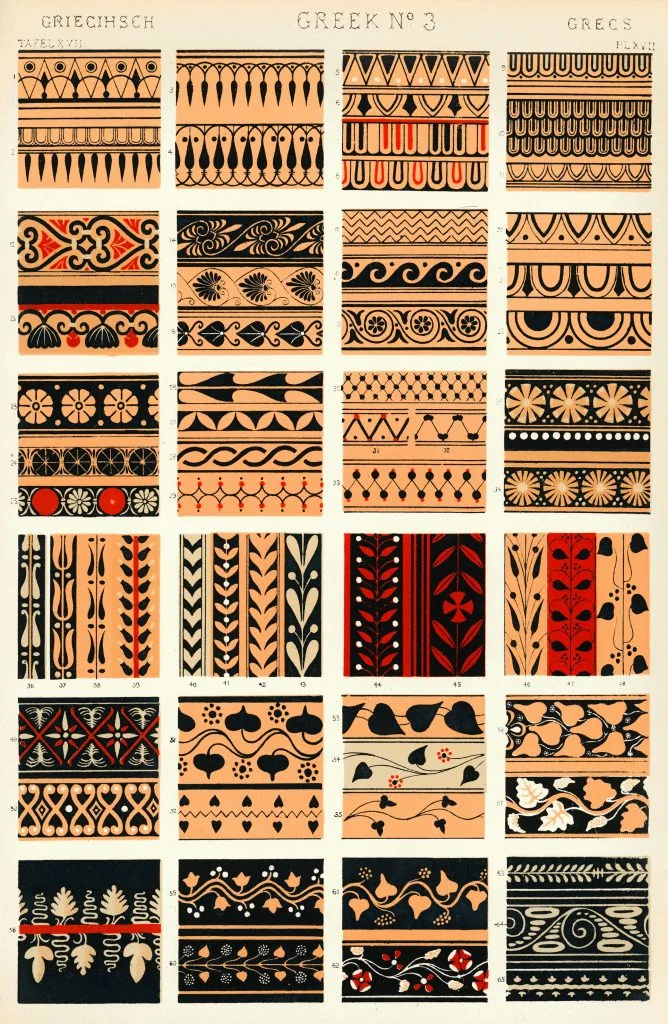
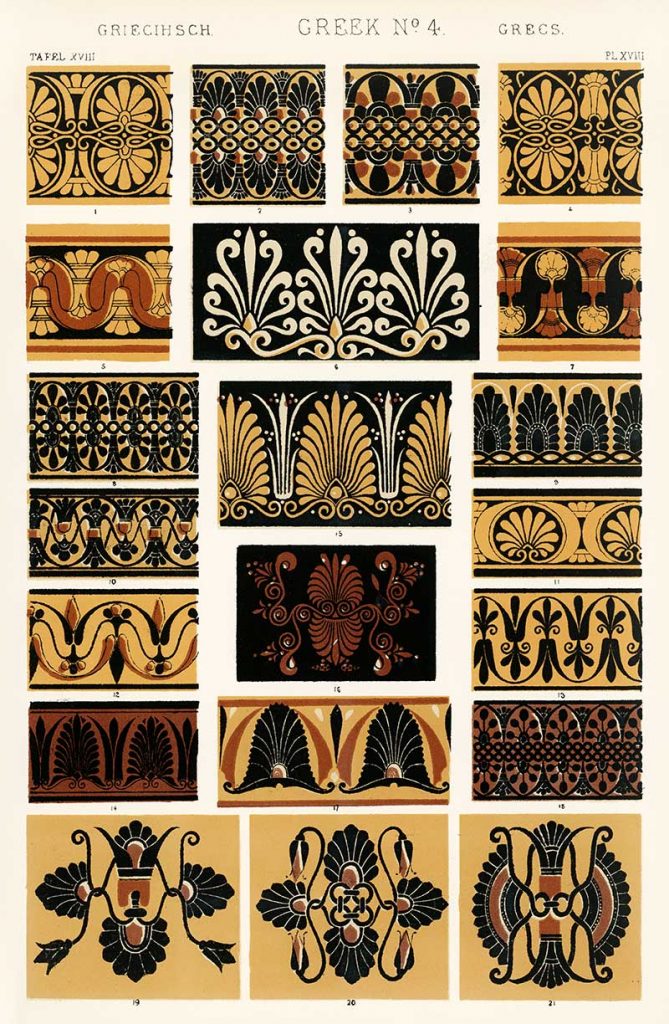
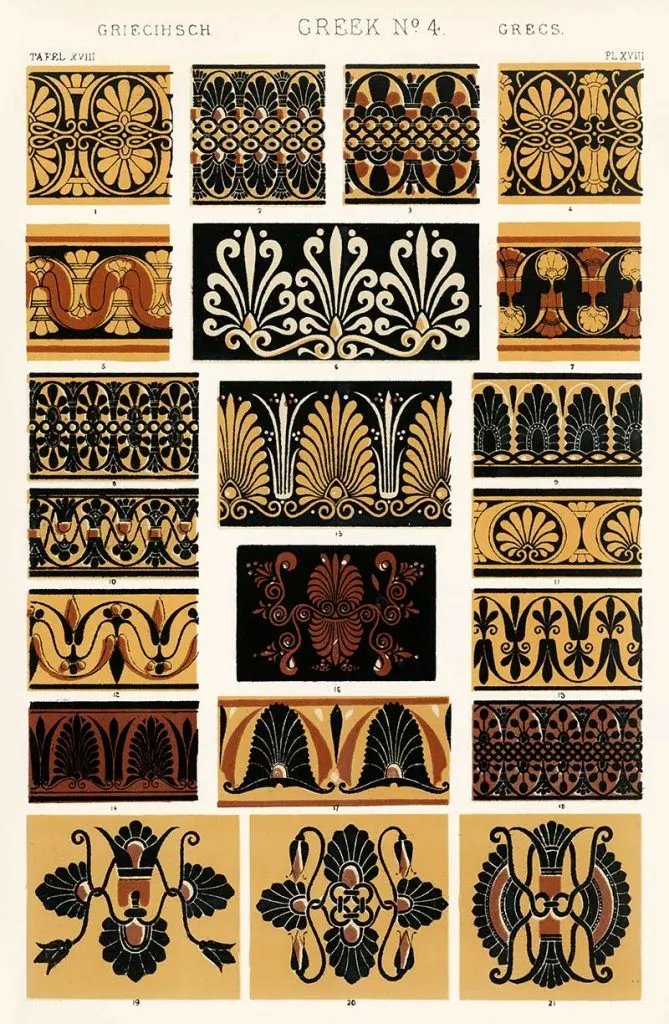
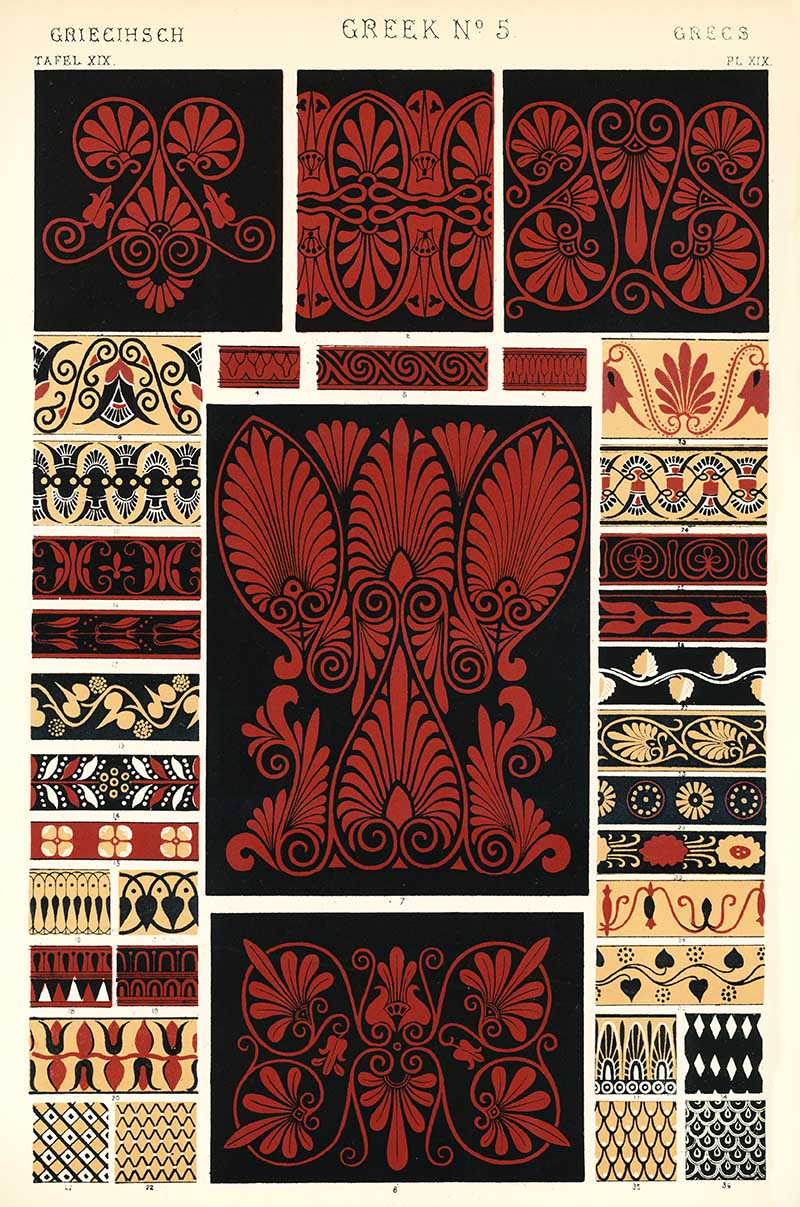
The patterns include some from the Sarcophagus in Sicily, the Propylaea in Athens and various Frets from the Temples in Athens.
Pompeian Ornament
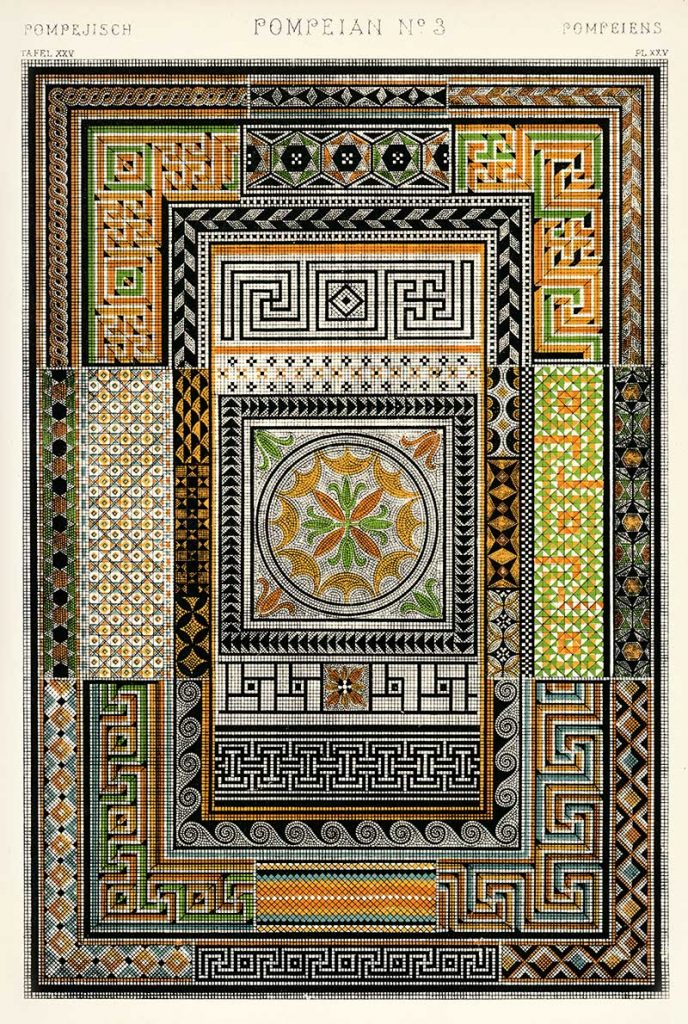
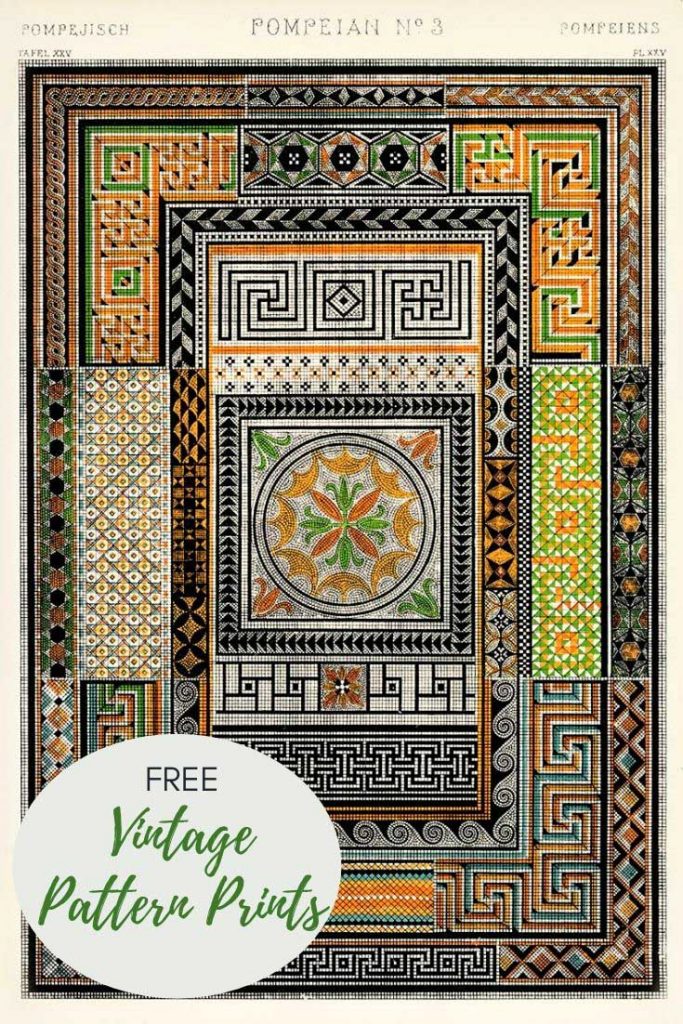
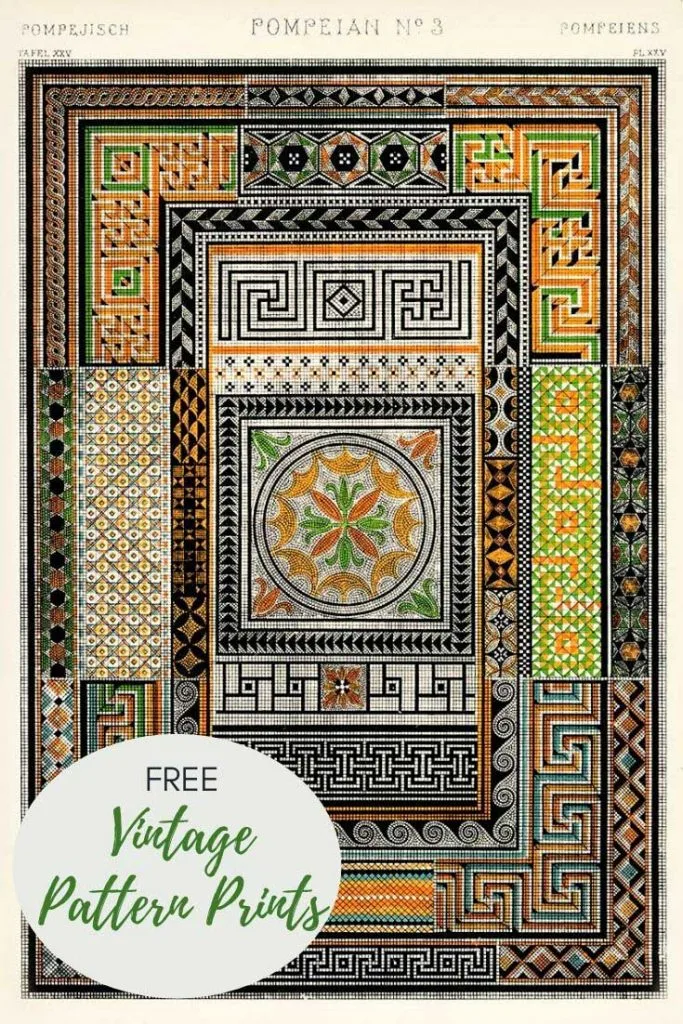
Below is a collection of mosaics from Pompeii in the Museum of Naples. These mosaic patterns seem very familiar. A group of homewares in Anthropologie called Bistro appears to be heavily influenced by these patterns.
Byzantine Ornament
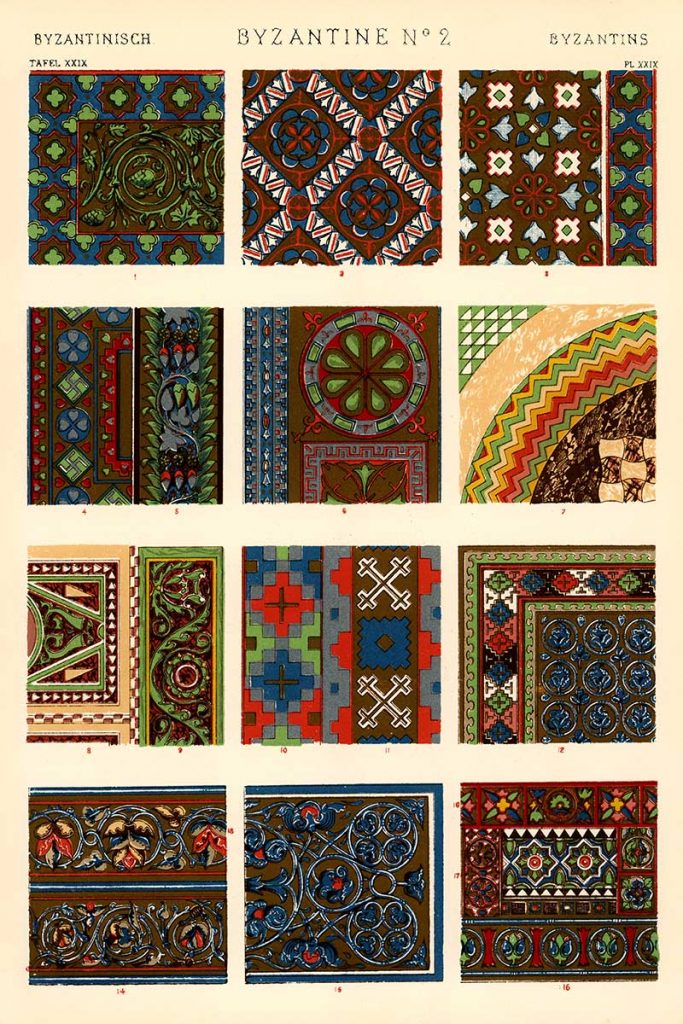
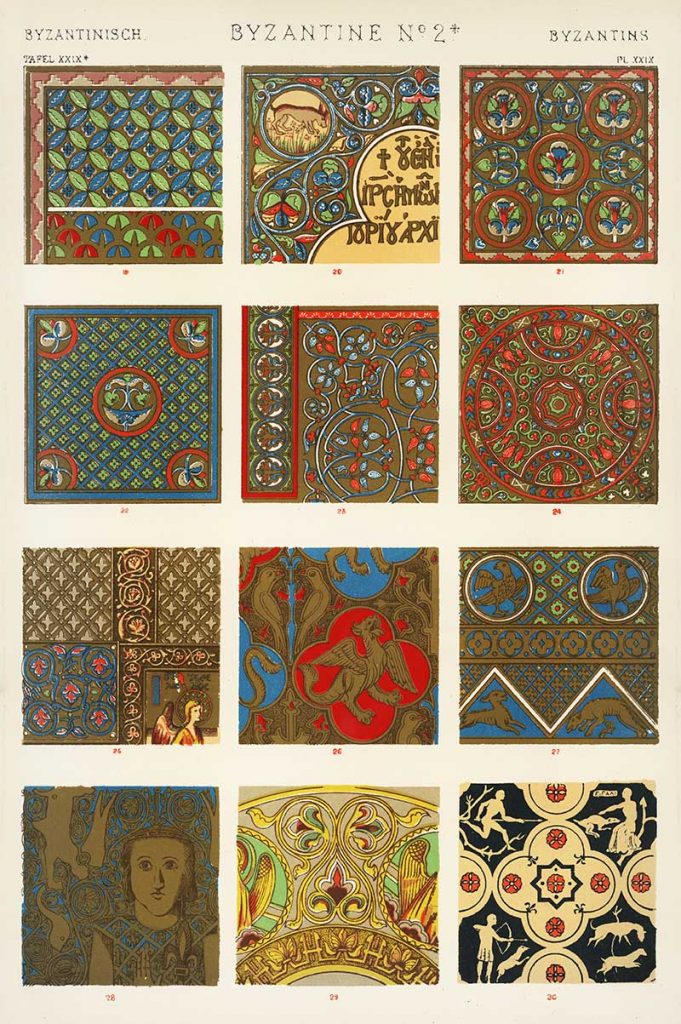
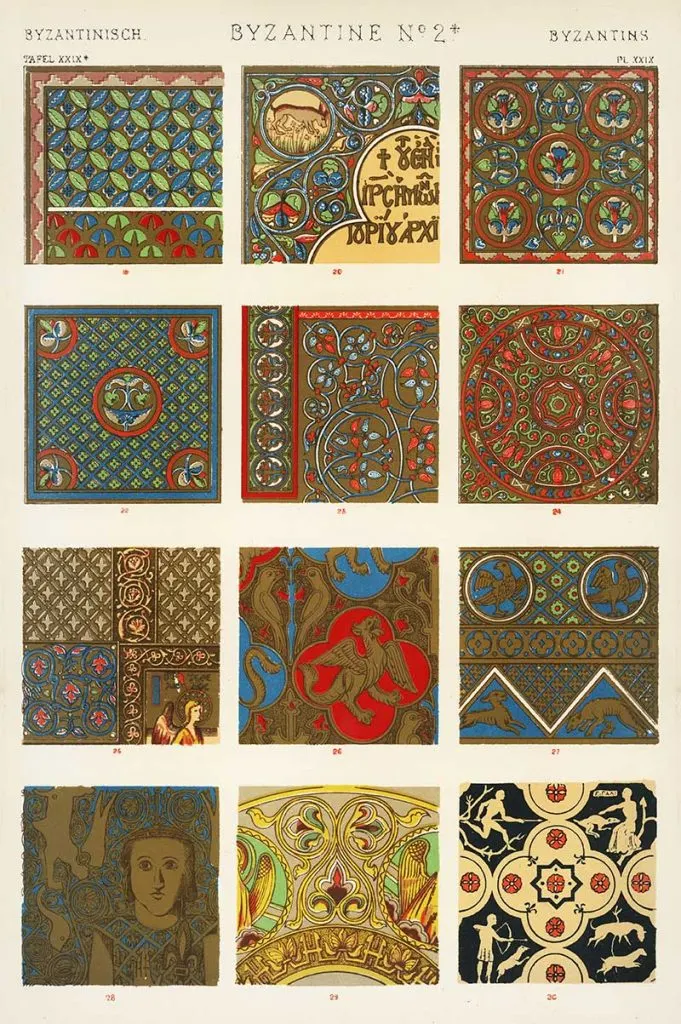
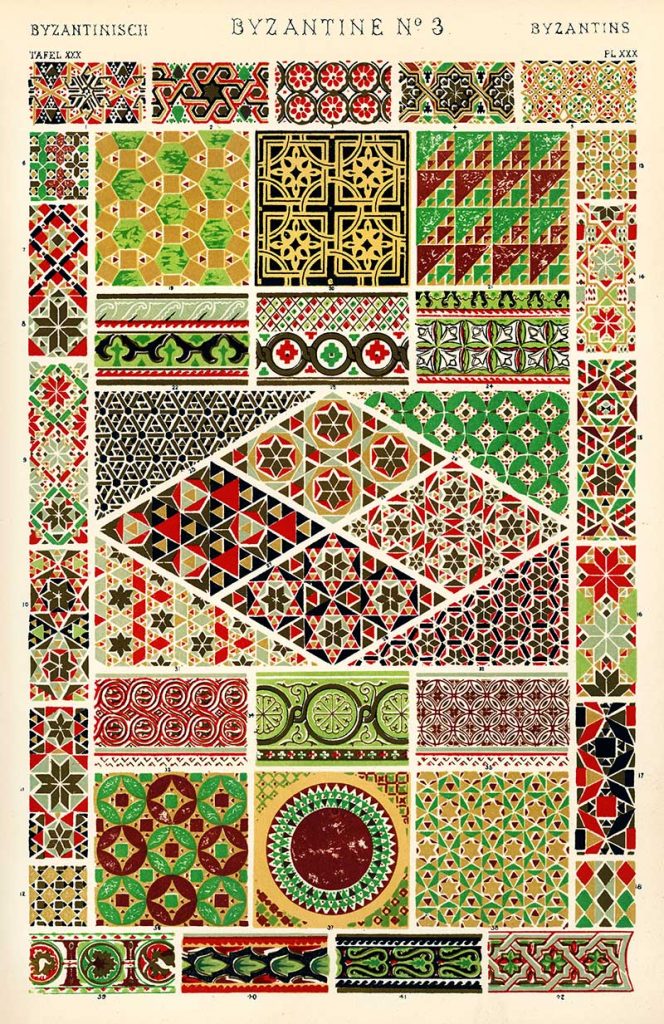
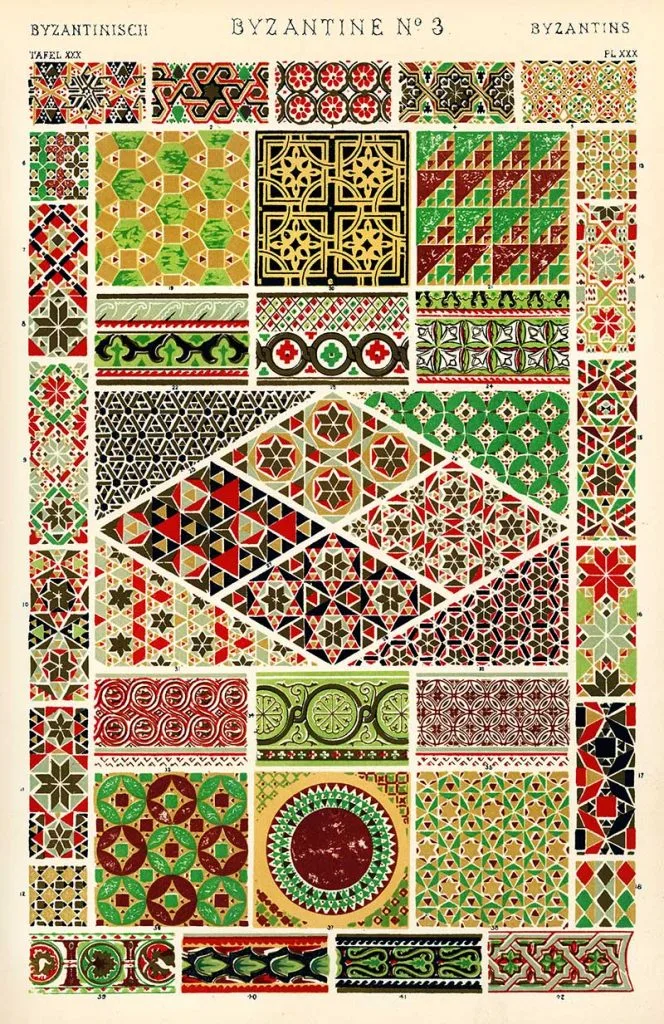
The Byzantine Empire was the continuation of the Roman Empire in its eastern provinces during Late Antiquity and the Middle Ages, with its capital at Constantinople (modern Istanbul, formerly Byzantium).
Arabian Ornament
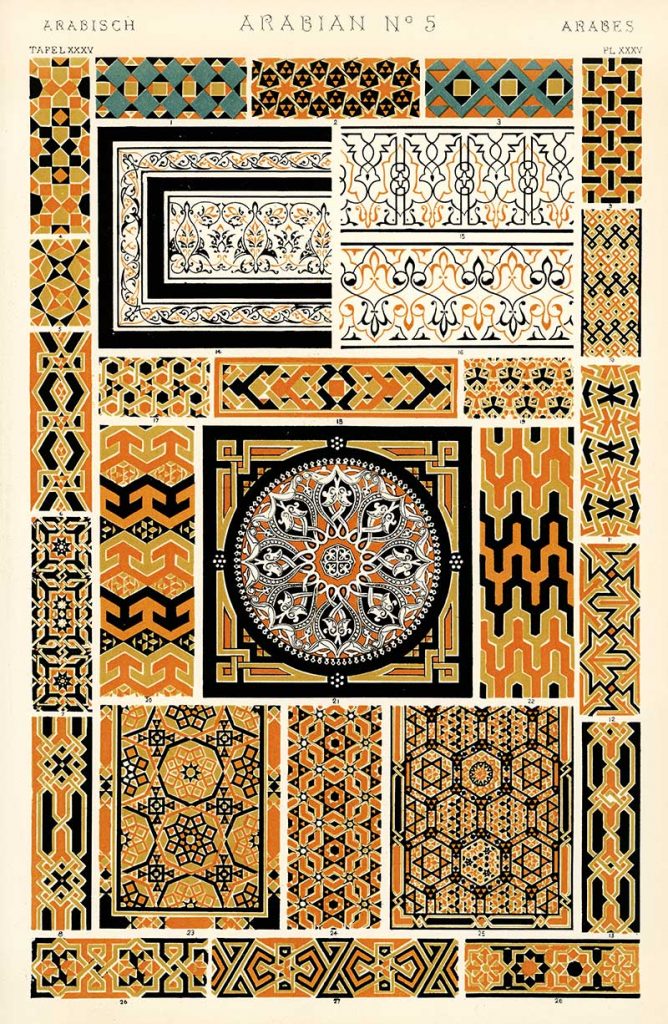
This print consists of different mosaics taken from pavements and walls in private houses and mosques in Cairo.
Moresque Ornament
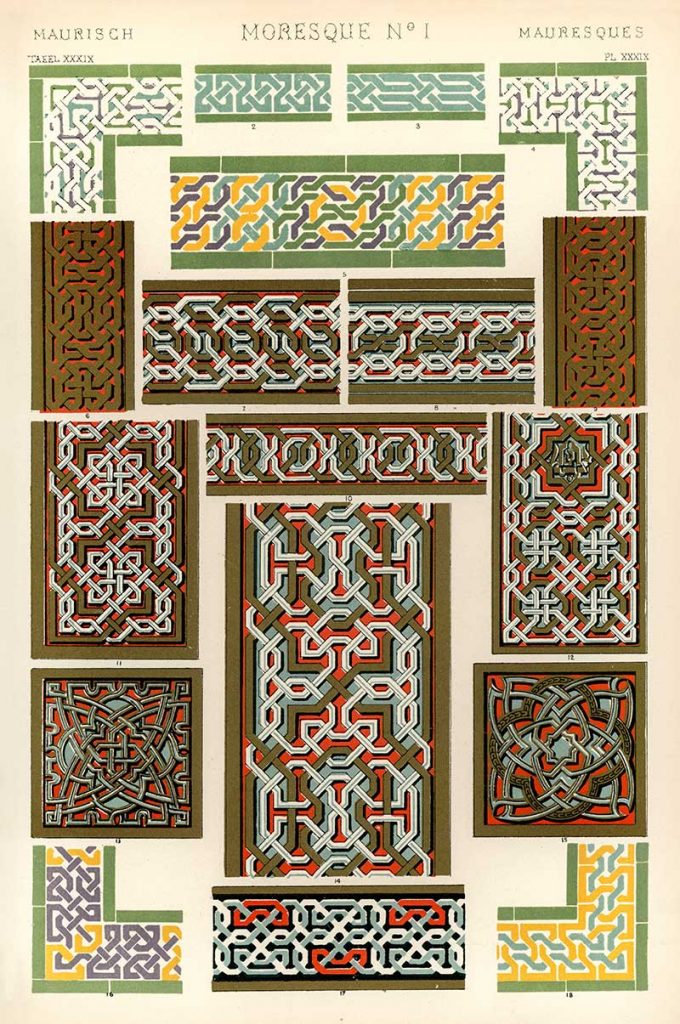
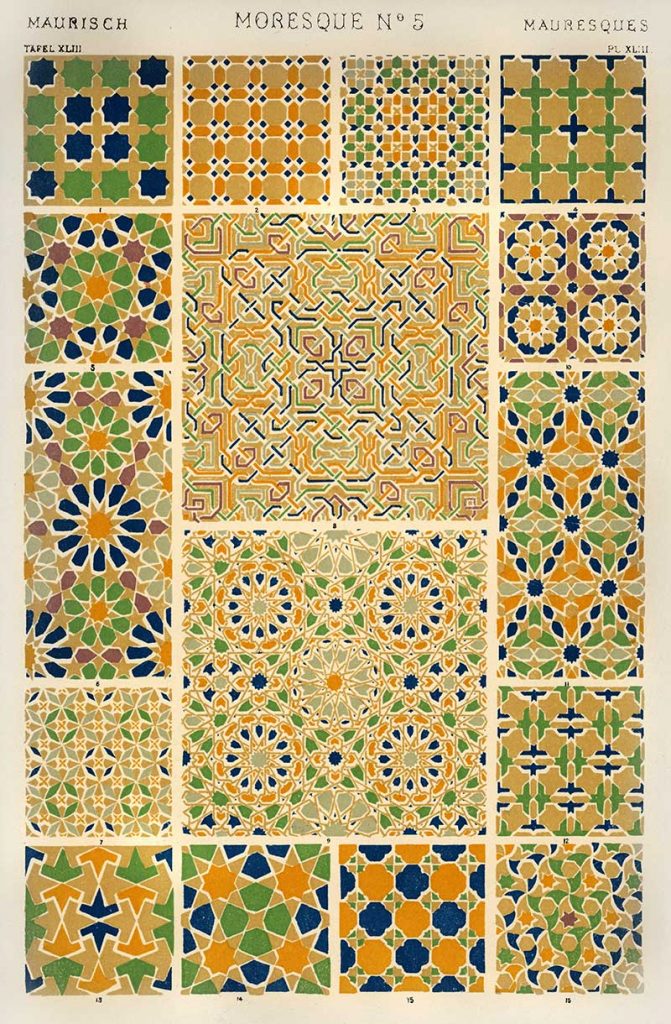
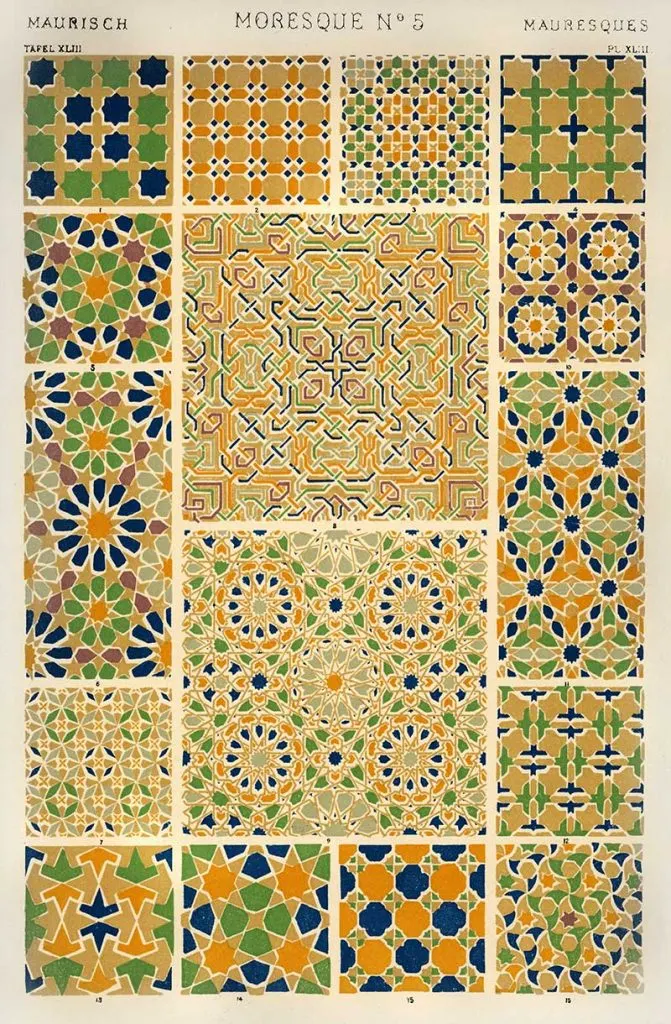
The Moresque Ornaments in the Grammar of Ornament are from the Alhambra Palace in Granada, Spain.
Persian Ornament
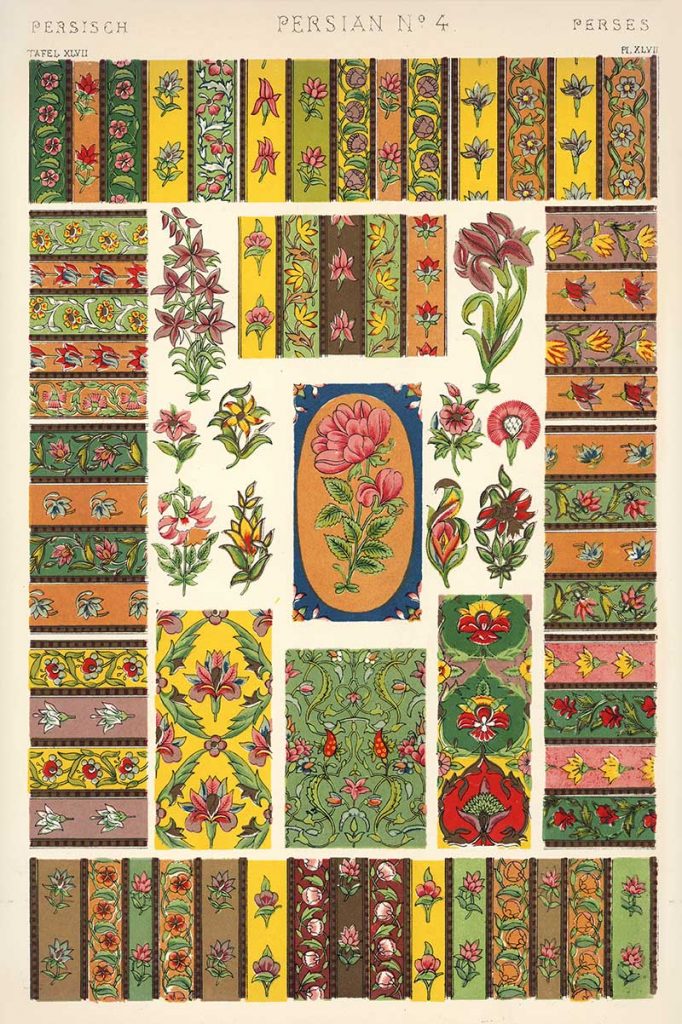
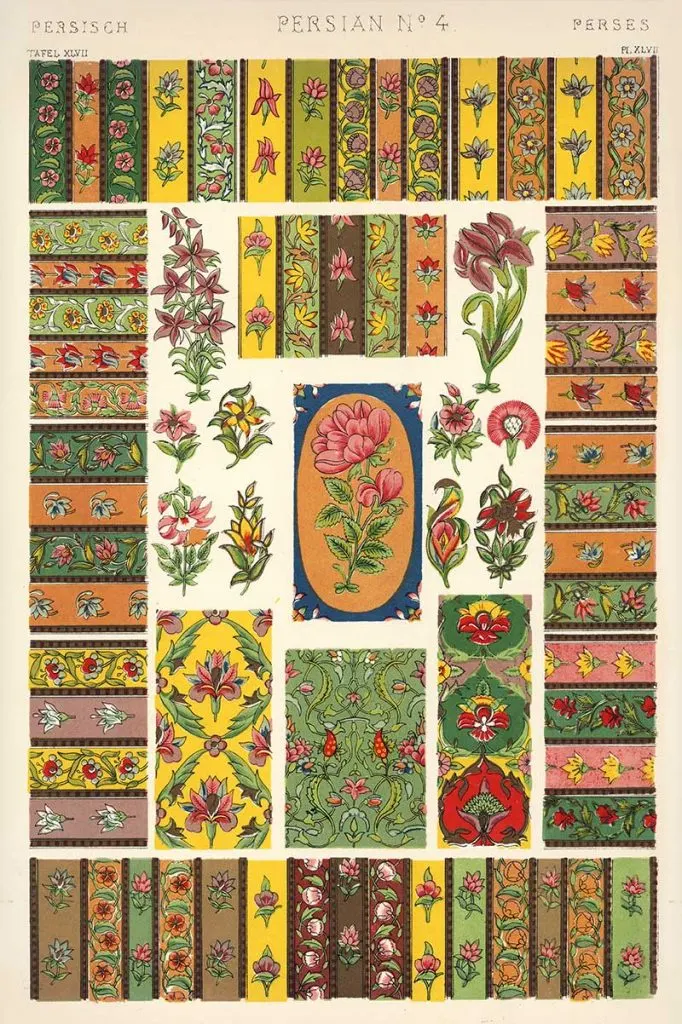
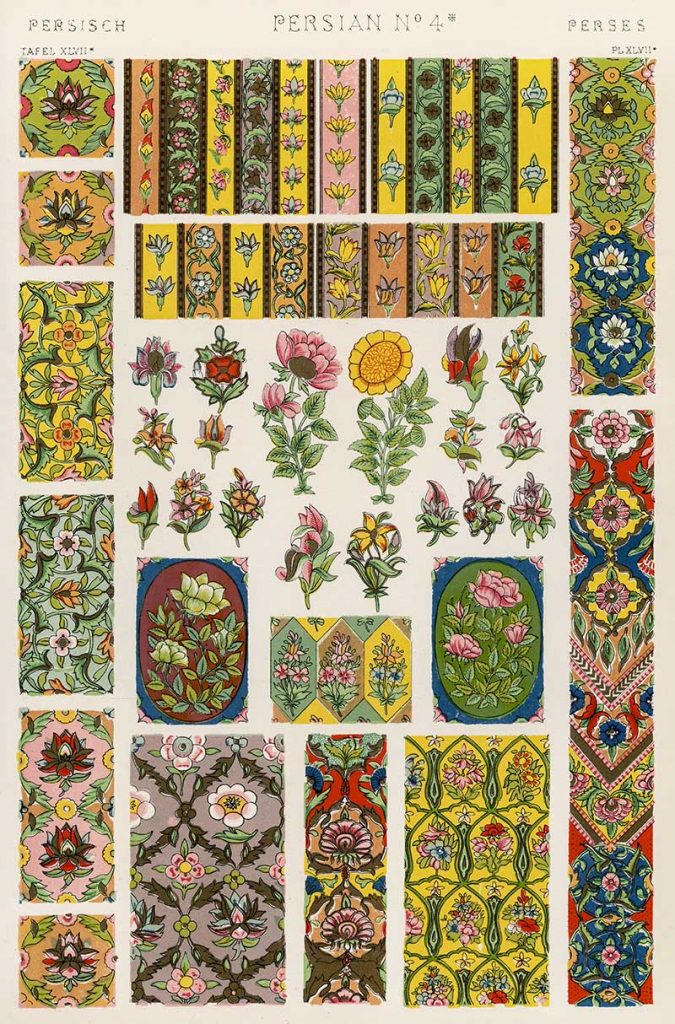
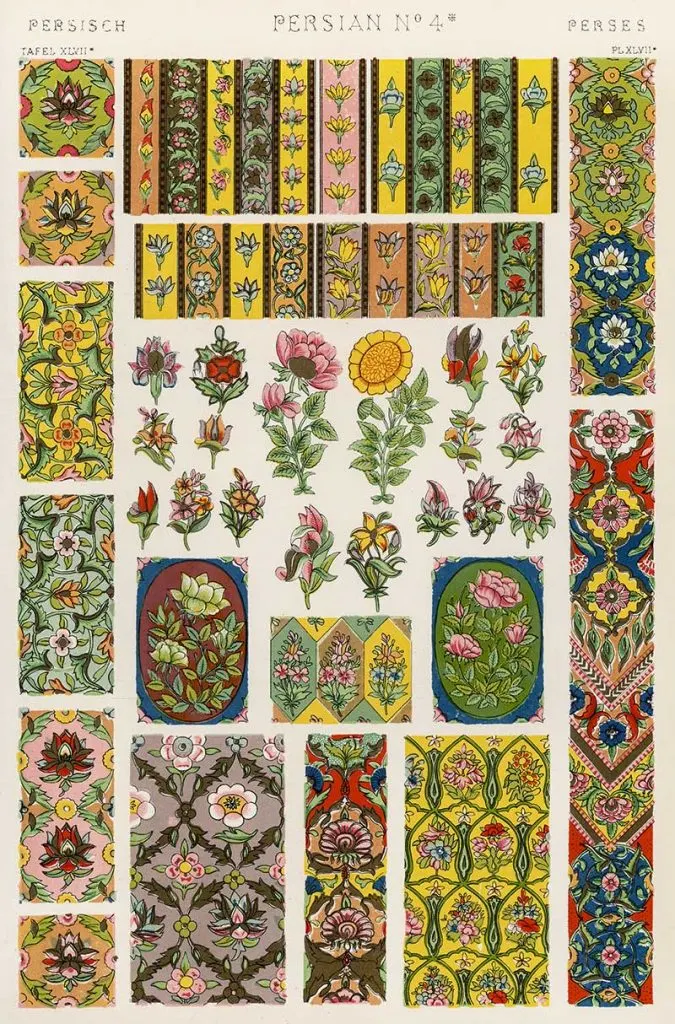
The patterns in this and the next plate are from Persian artefacts in the British Museum.
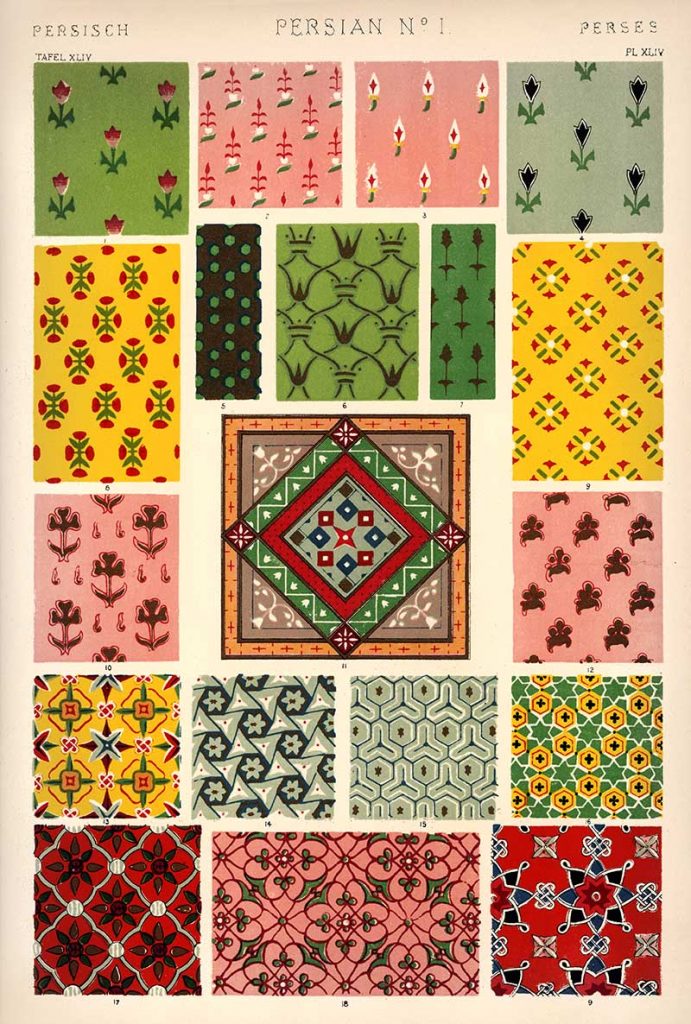
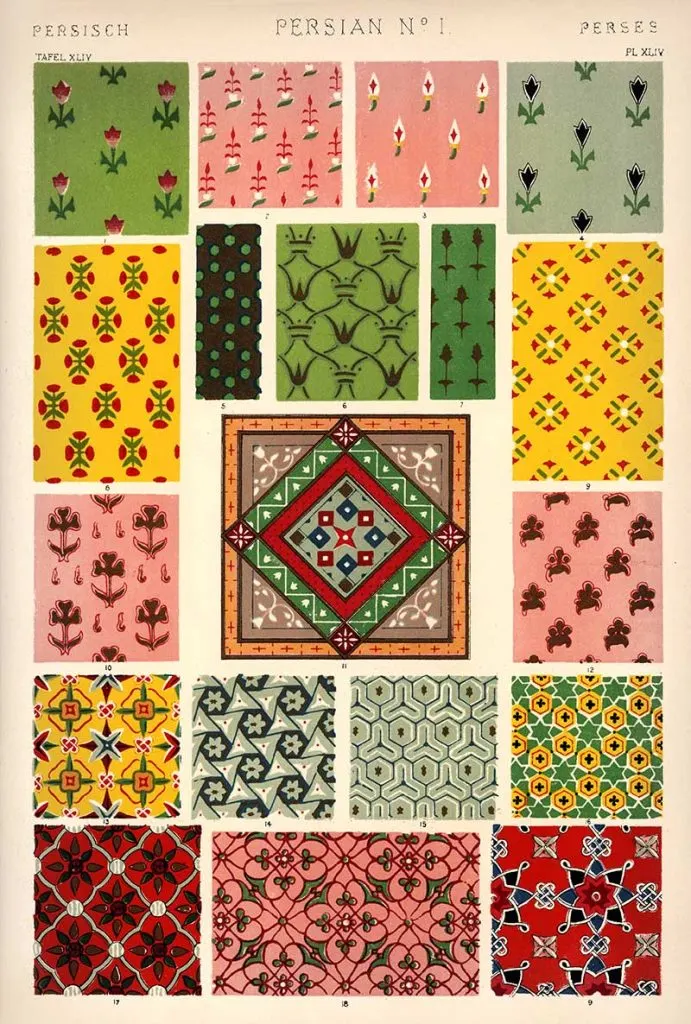
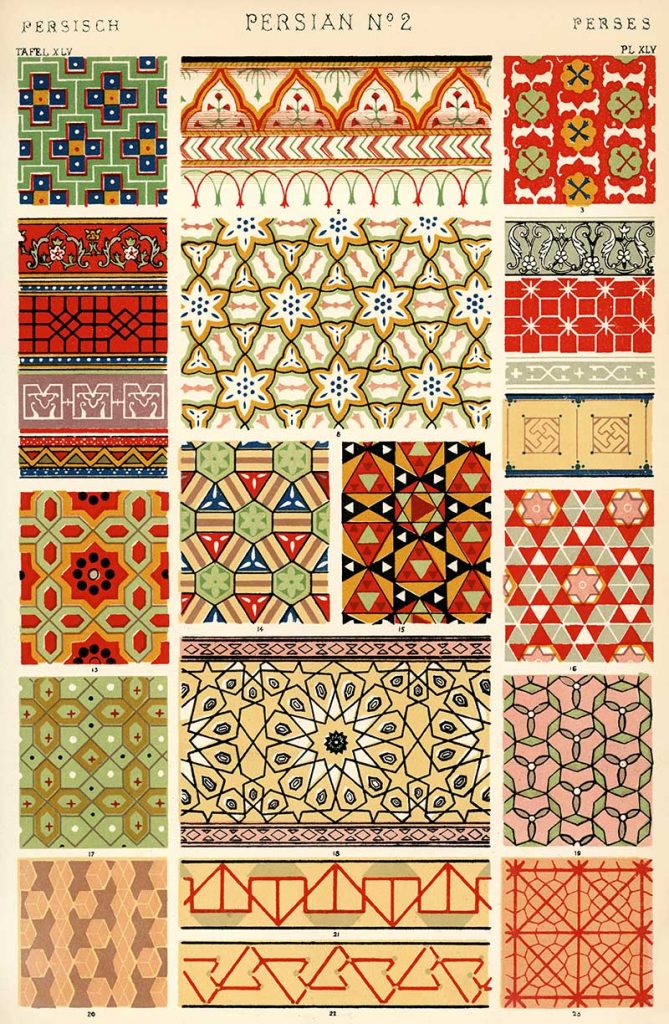
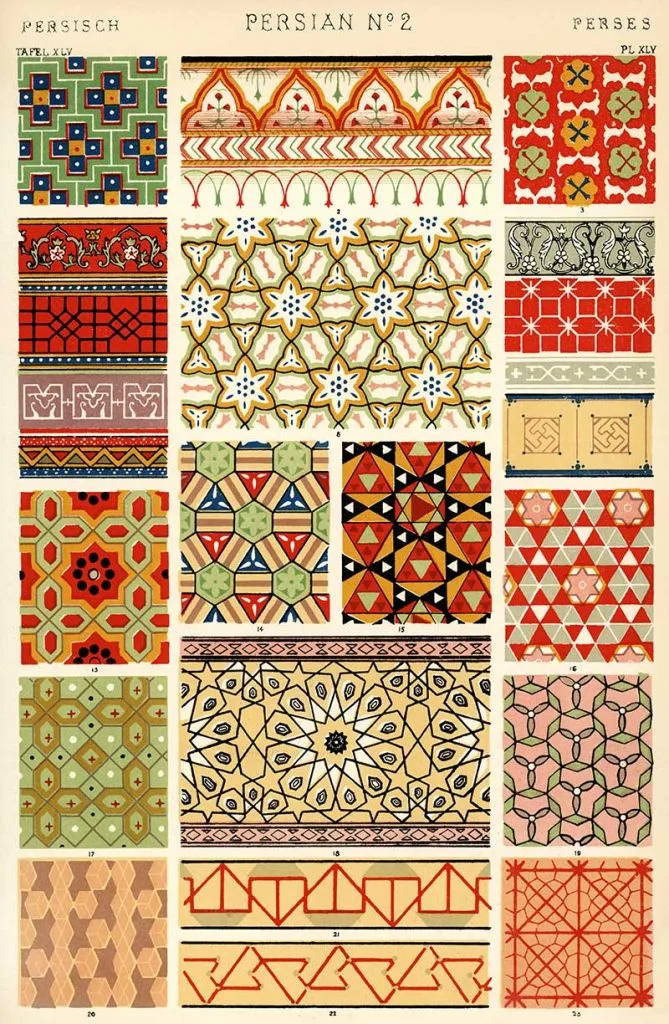
The patterns and designs in this and the next plate are from a Persian manufacturer’s pattern book. I like all the floral motifs.
Indian Ornament
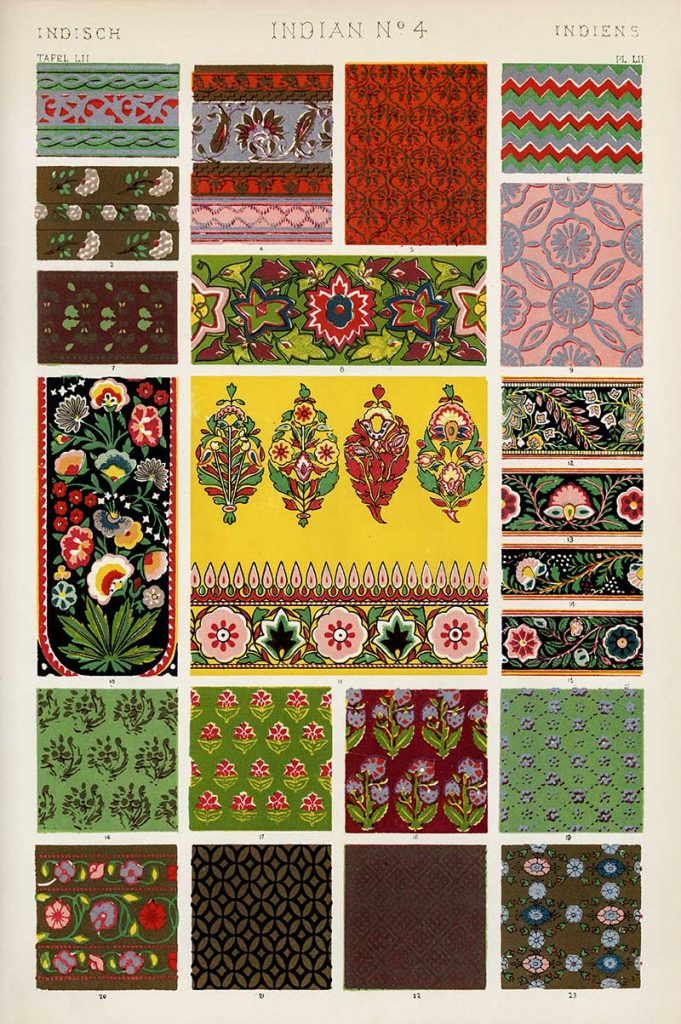
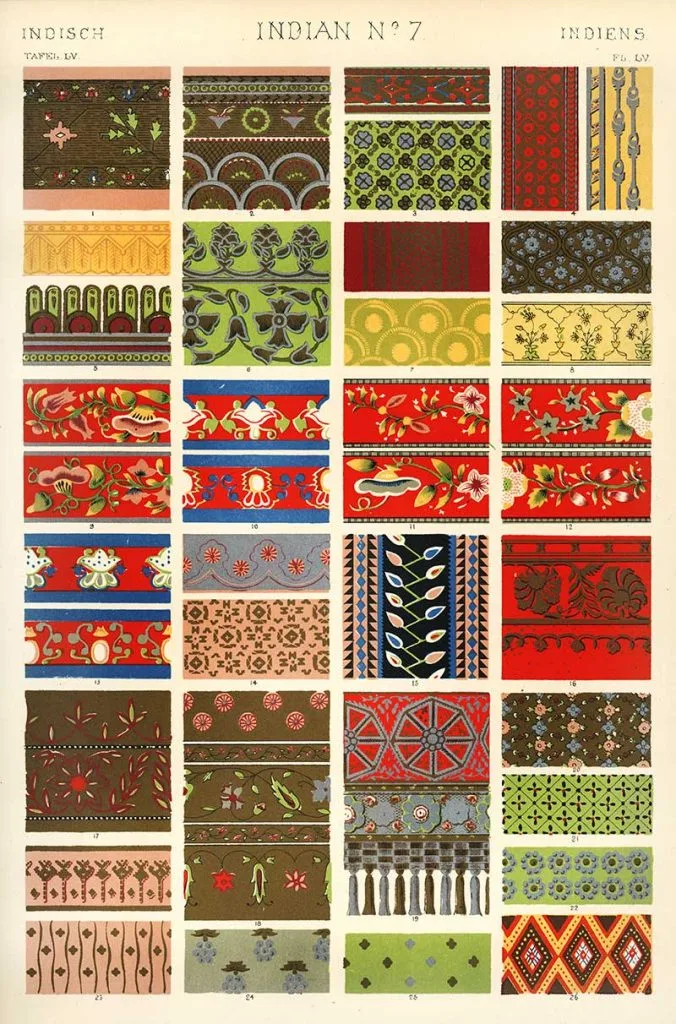
Owen Jones’ Grammar of Ornament, Indian plates.
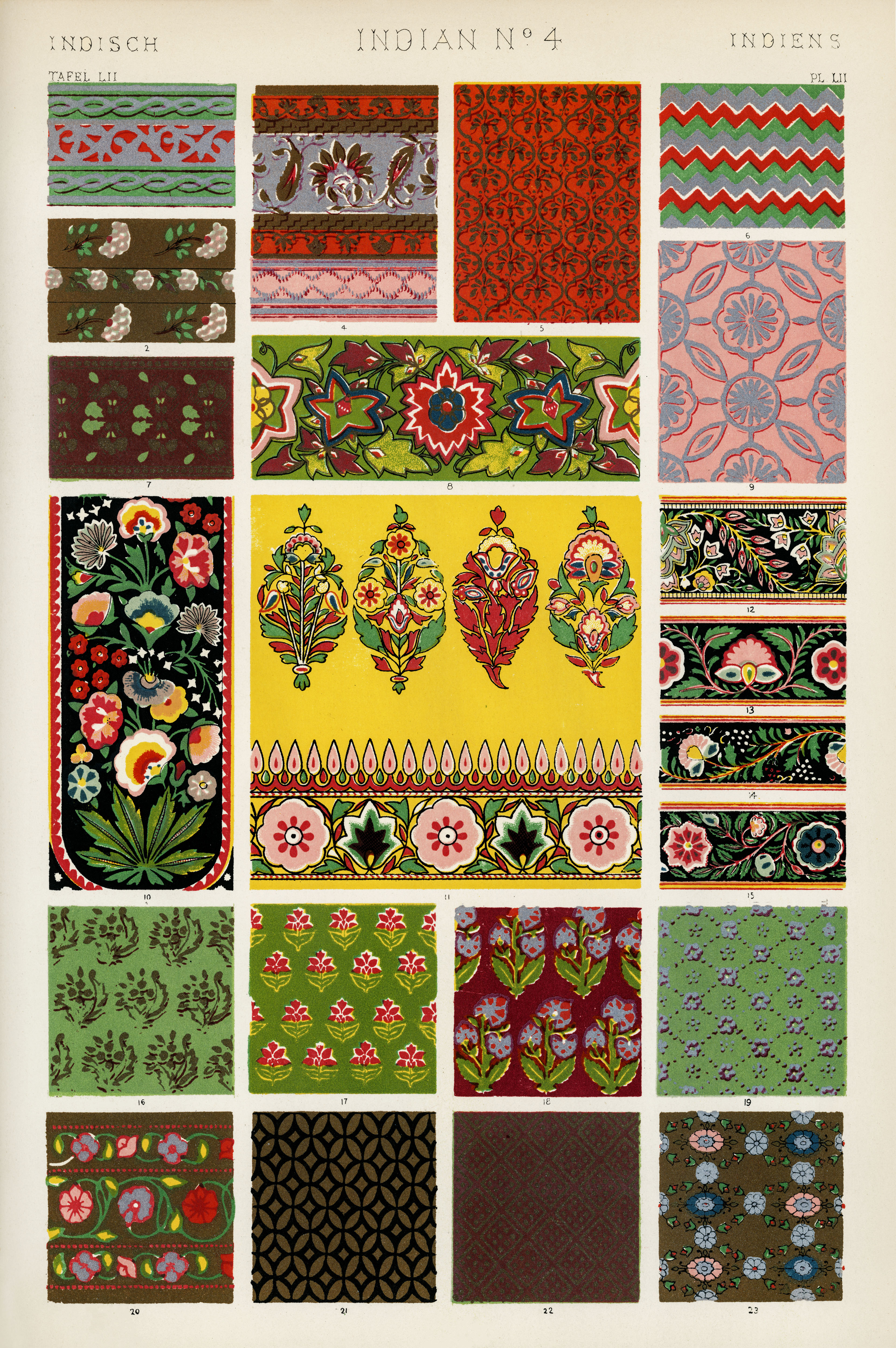
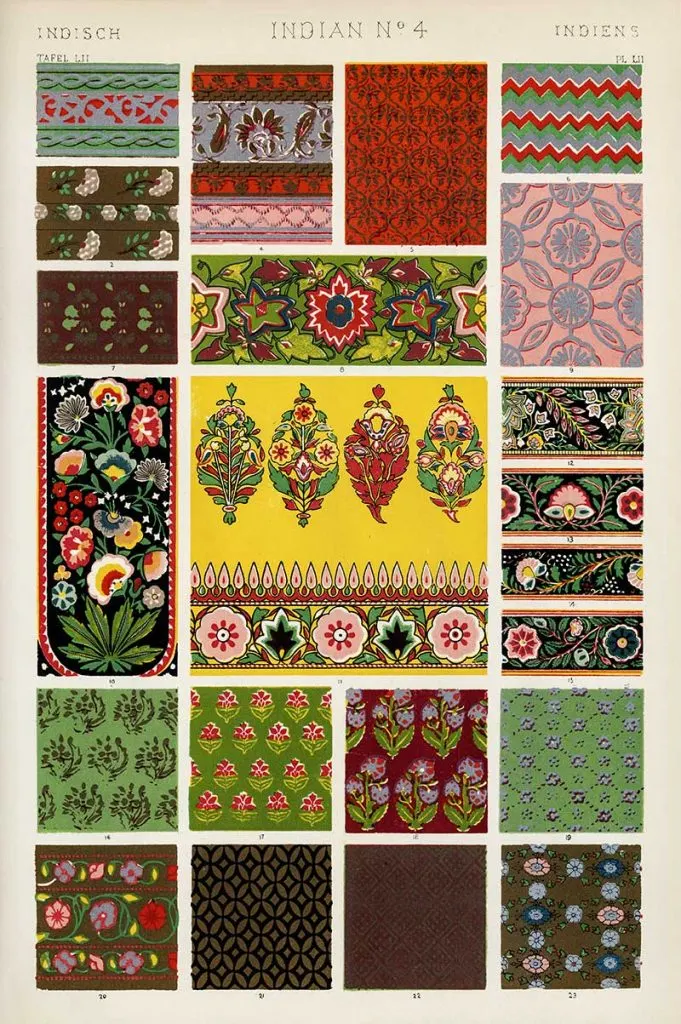
Vintage patterns from embroidered and woven fabrics and paintings on vases were exhibited in the Indian Collection in 1881 and are now at Marlborough House.
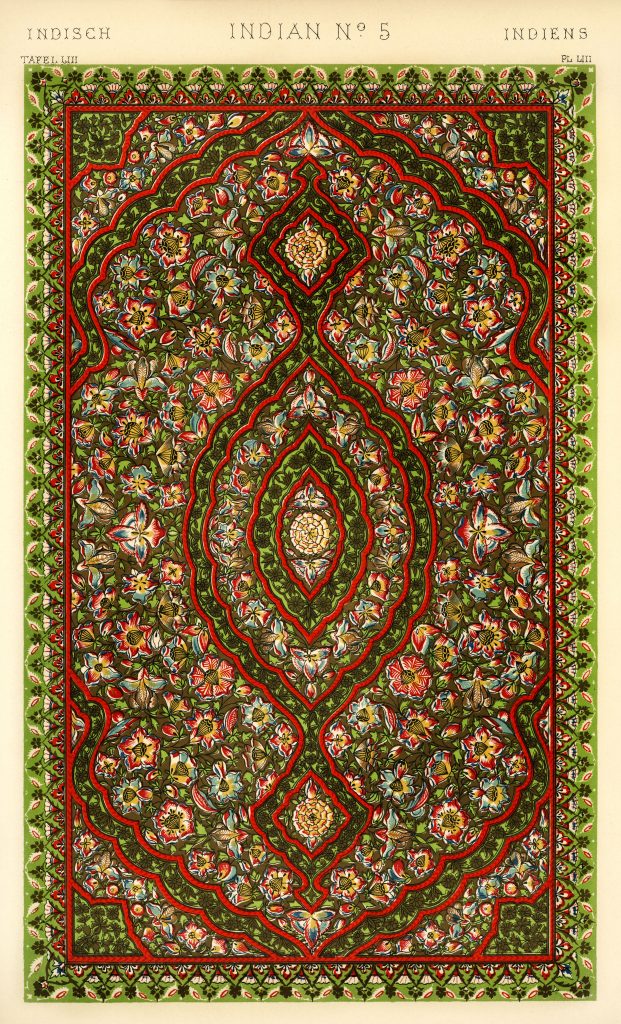
Below is a specimen of painted lacquer work from the collection at the India House.
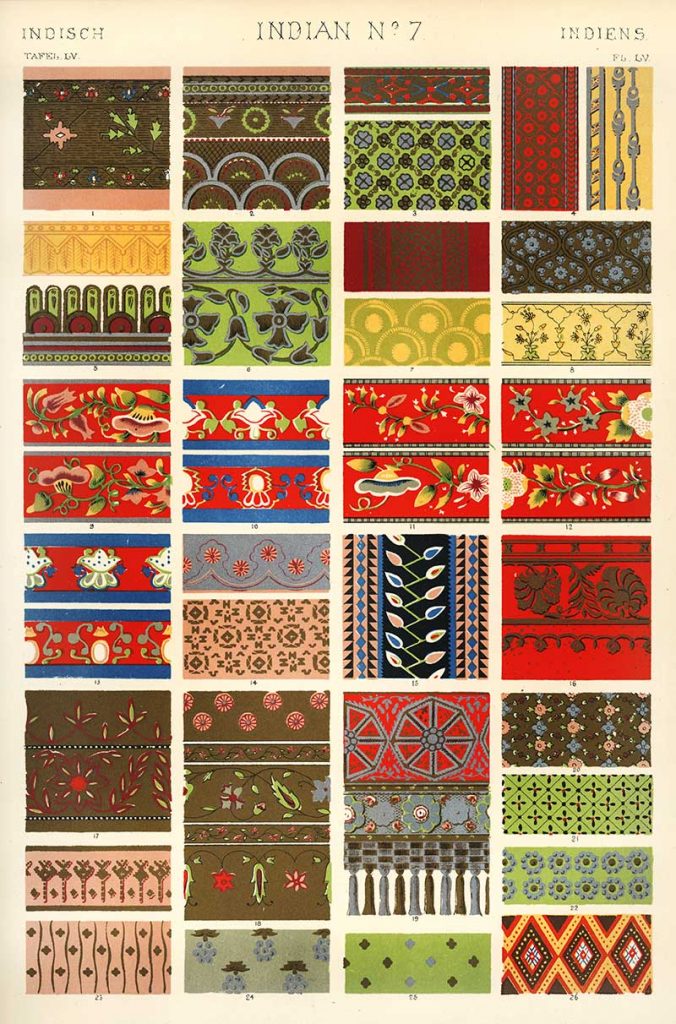
Patterns from woven and embroidered fabrics and painted boxes were exhibited in the Indian Collection in Paris in 1855.
Chinese Ornament
Even though Owen acknowledges that the Chinese are an ancient civilisation that achieved many firsts, he is pretty scathing of their progression, especially in the fine arts.
“In their ornamentation, with which the world is so familiar through the numerous manufactured articles of every kind which have been imparted into this country, they do not appear to have gone beyond that point which every people reach in an early stage of civilization: their art such as it is, is fixed, and a subject neither to progression nor retrogression.“
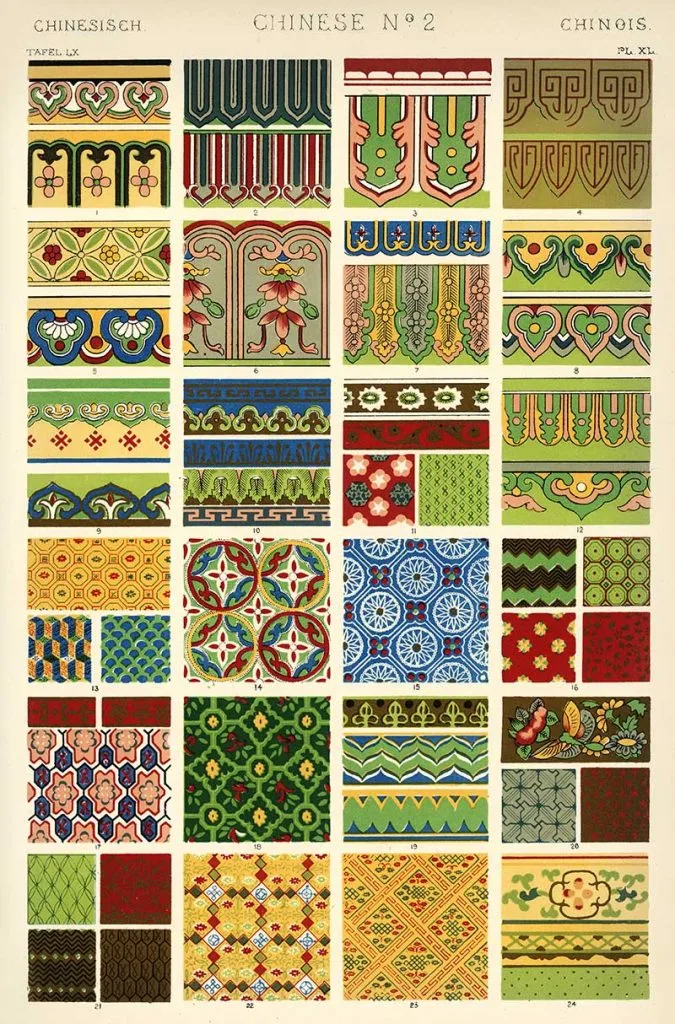
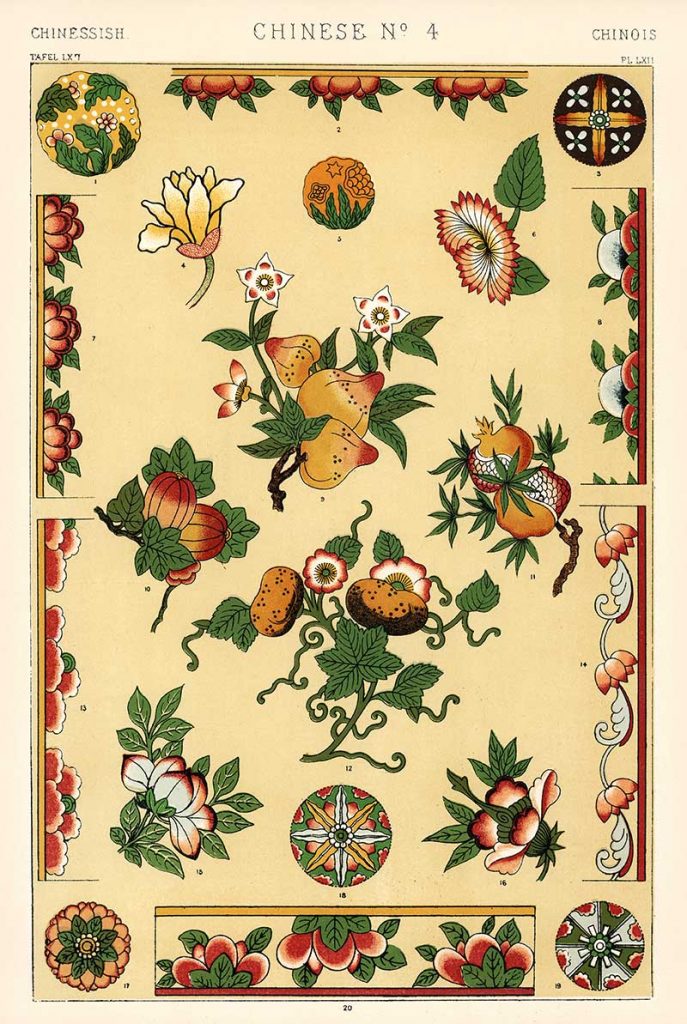
Below are patterns from both porcelain and paintings -more examples of the Chinoiserie in interiors are in this collection of watercolour paintings of Brighton Pavilion.
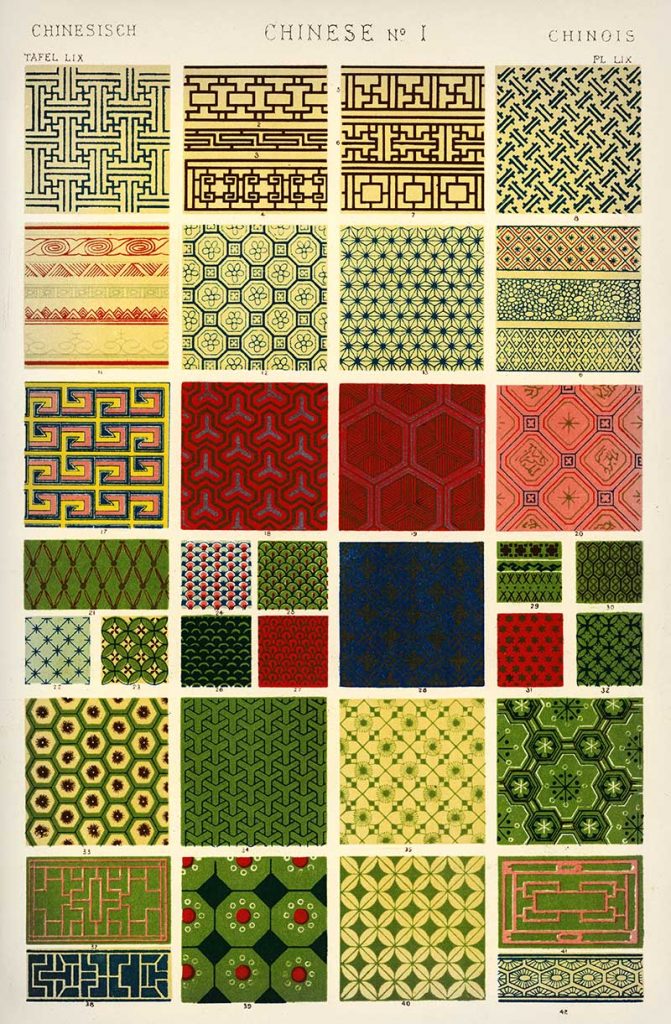
Examples of vintage patterns from Chinese porcelain, woven fabrics and wooden boxes.
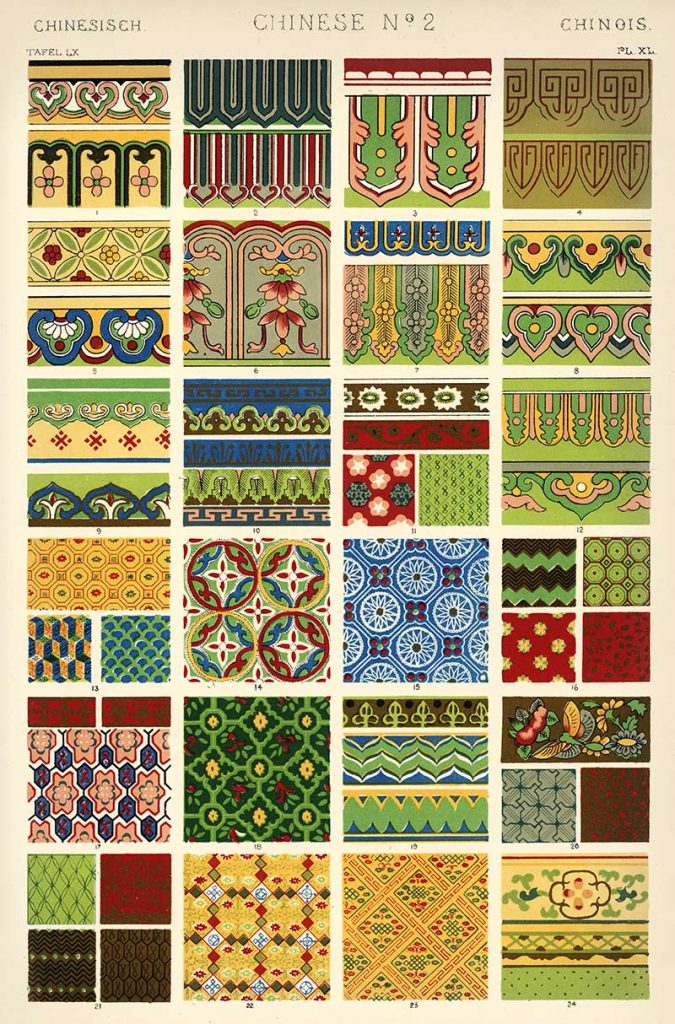
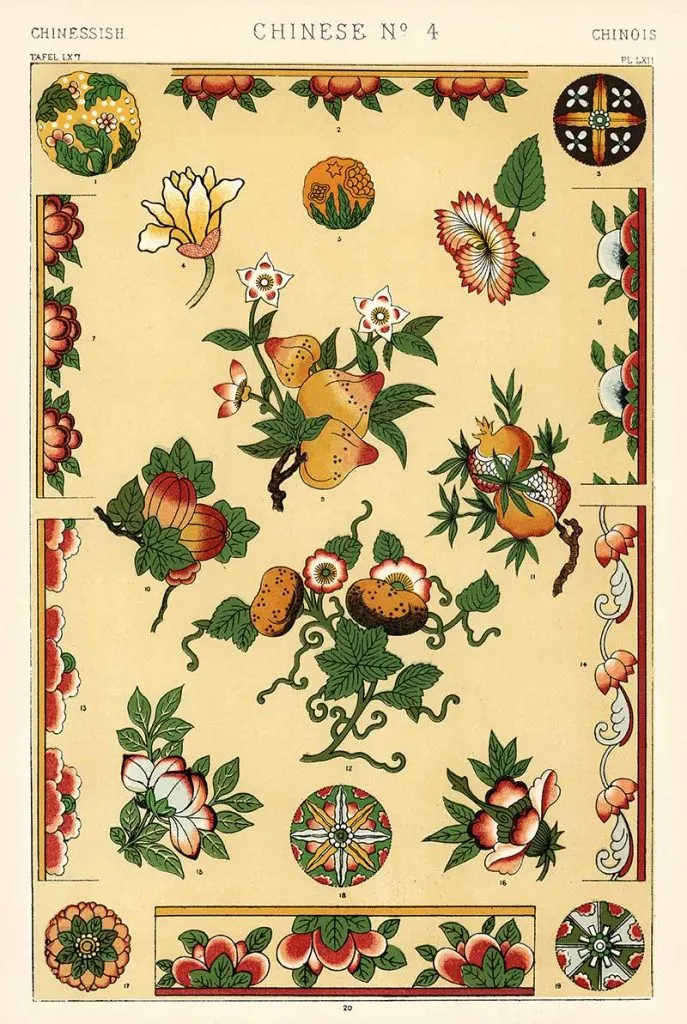
This vintage pattern print shows examples of conventional renderings of flowers and fruits painted on porcelain.
Celtic Ornament
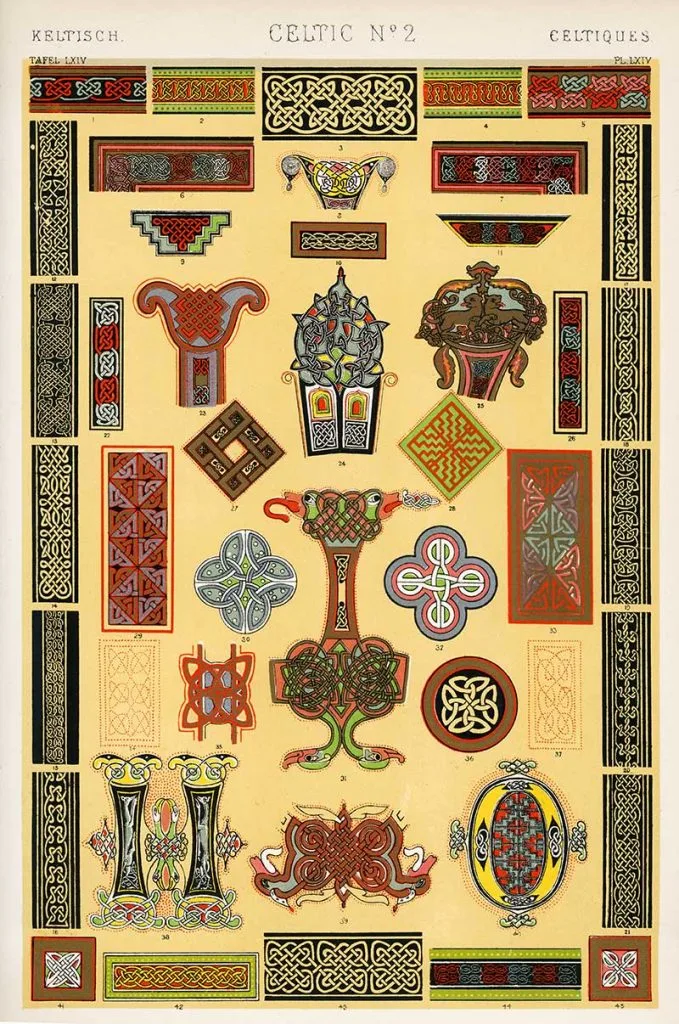
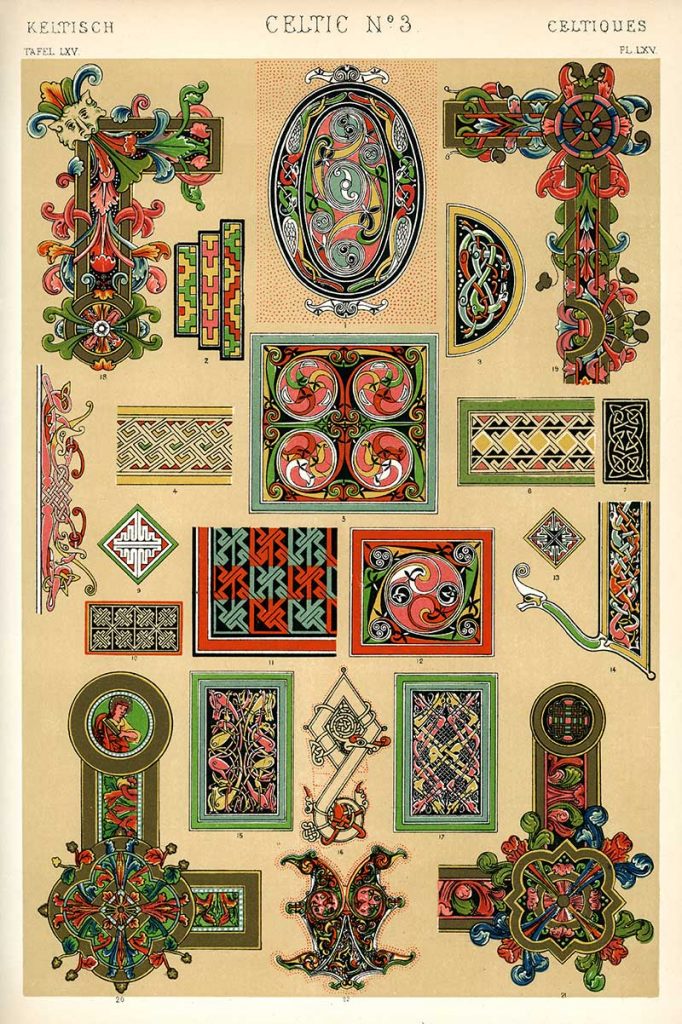
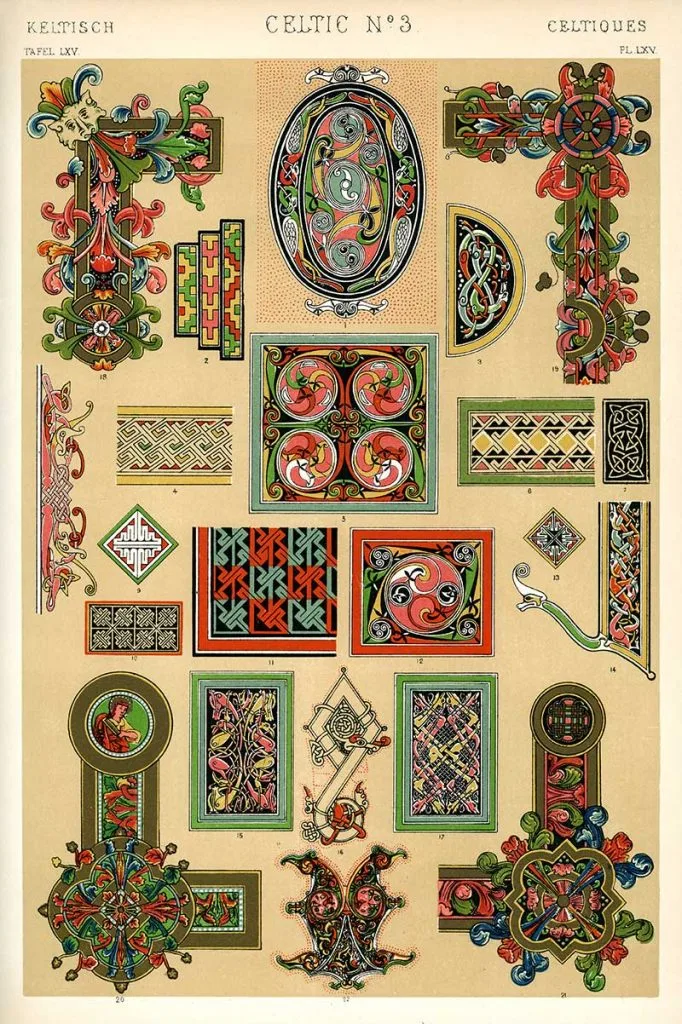
Owen Jones, in The Grammar of Ornament, describes the uniqueness of Celtic art as follows.
“The chief peculiarities of the Celtic Ornamentation consist first, in the entire absence of foliage or other phyllomorphic or vegetable ornament. And secondly, the extreme intricacy and excessive minuteness and elaboration of the various patterns, mostly geometrical, consisting of interlace ribbon-work, diagonal or spiral lines and strange monstrous animals and birds, with long top-knots, tongues, and tails, intertwining in almost endless knots.”
Ornaments showing examples of the Celtic interlaced style.
The interlace patterns, often regarded as typical of “Celtic art,” were characteristic of the British Isles and are referred to as Insular art.
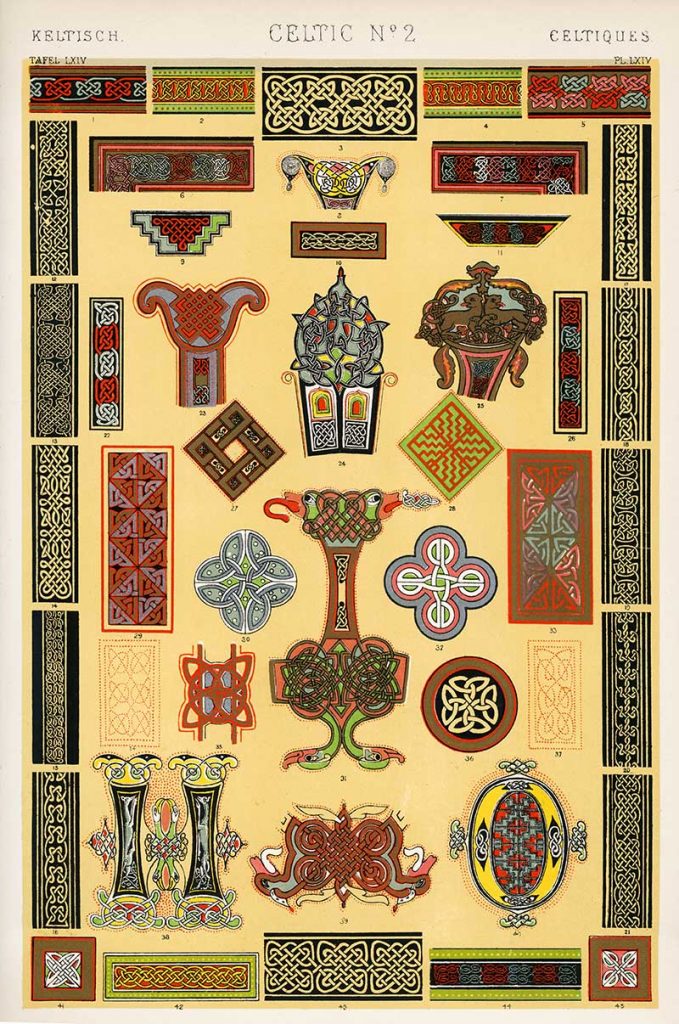
Spiral, diagonal, zoomorphic and later Anglo-saxon ornaments.
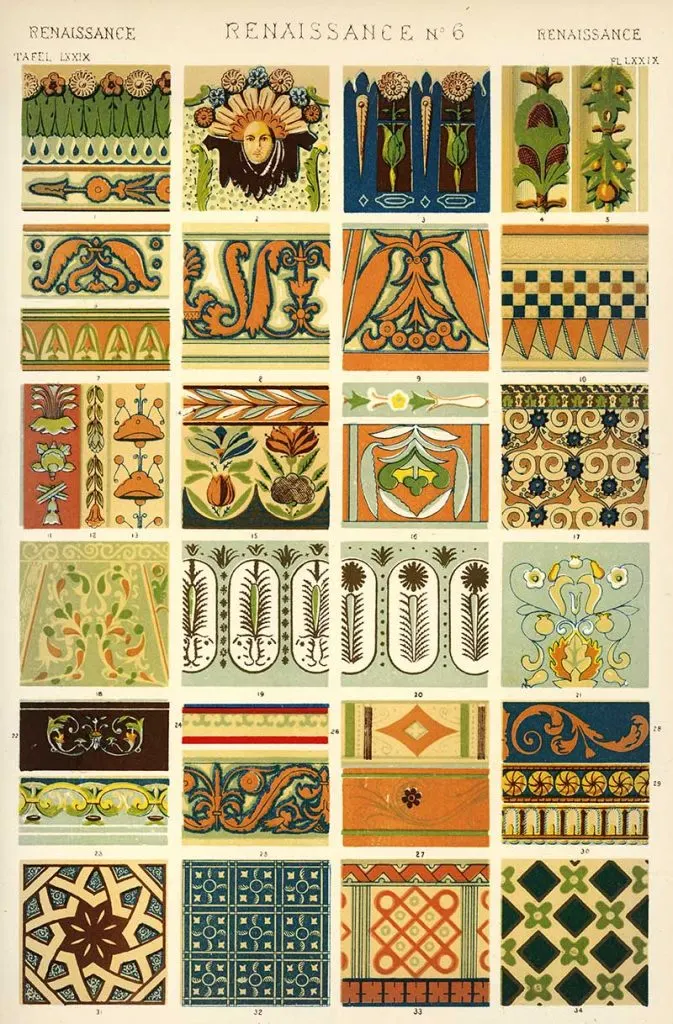
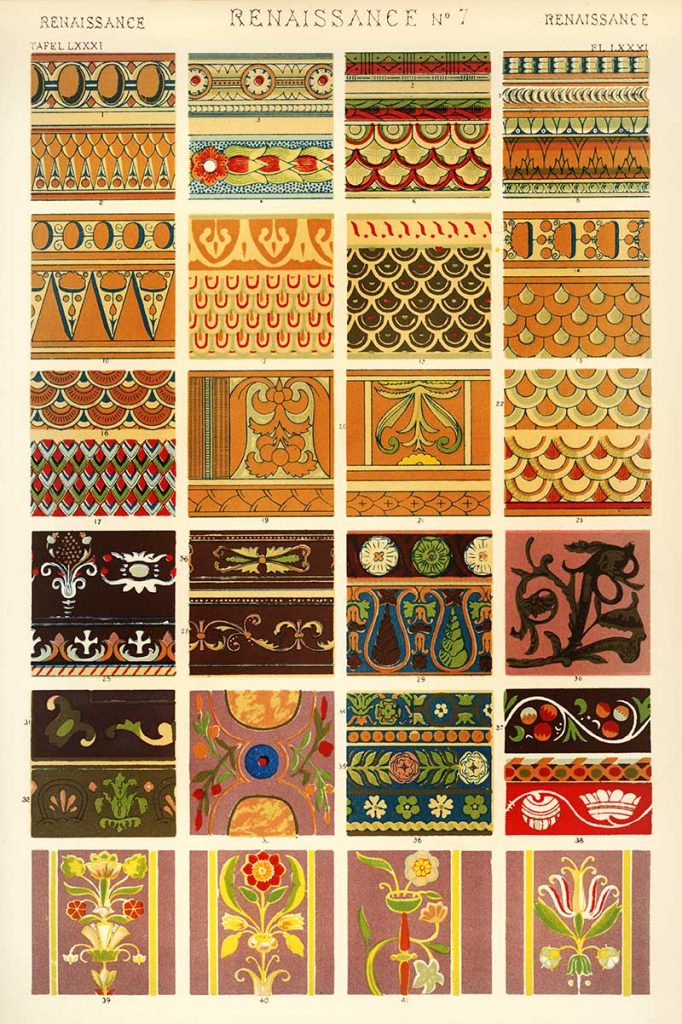
Renaissance Ornament
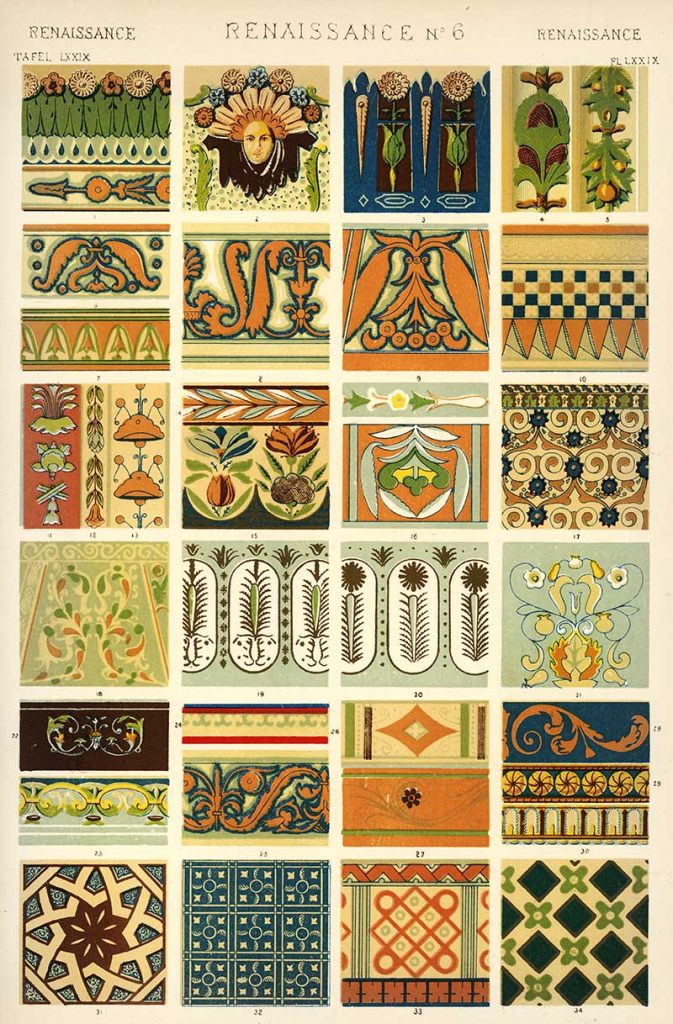
The Renaissance was a period in European history marking the transition from the Middle Ages to Modernity, spanning the 15th and 16th centuries.
Leaves And Flowers From Nature
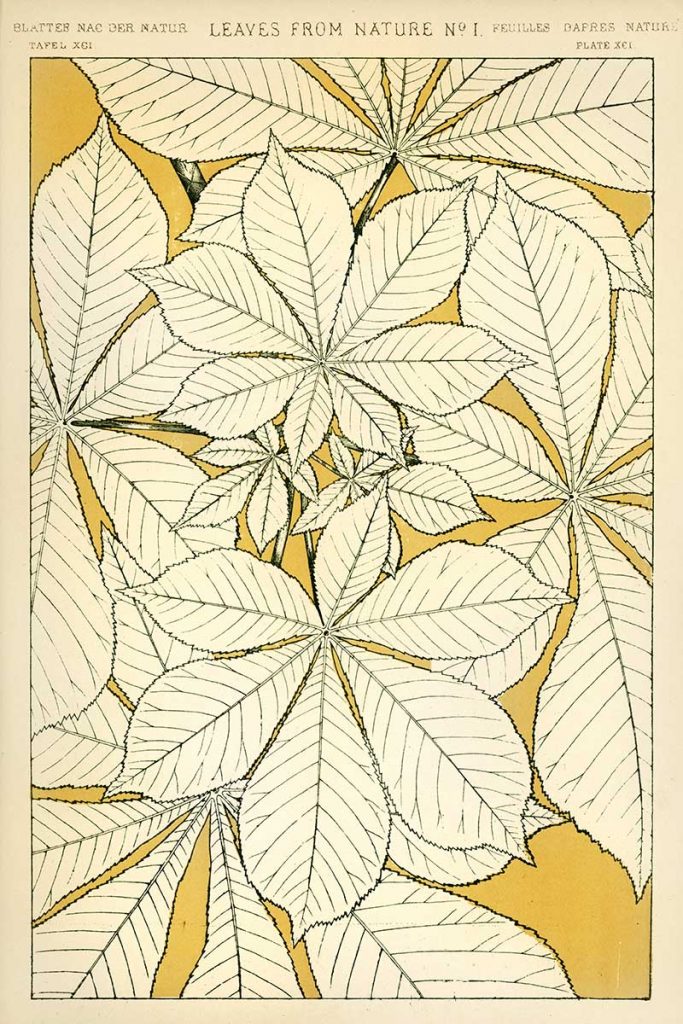
In the final chapter of Owen Jones’s Grammar of Ornament, his theories on the relationship between nature and the decorative arts through the centuries are explored.
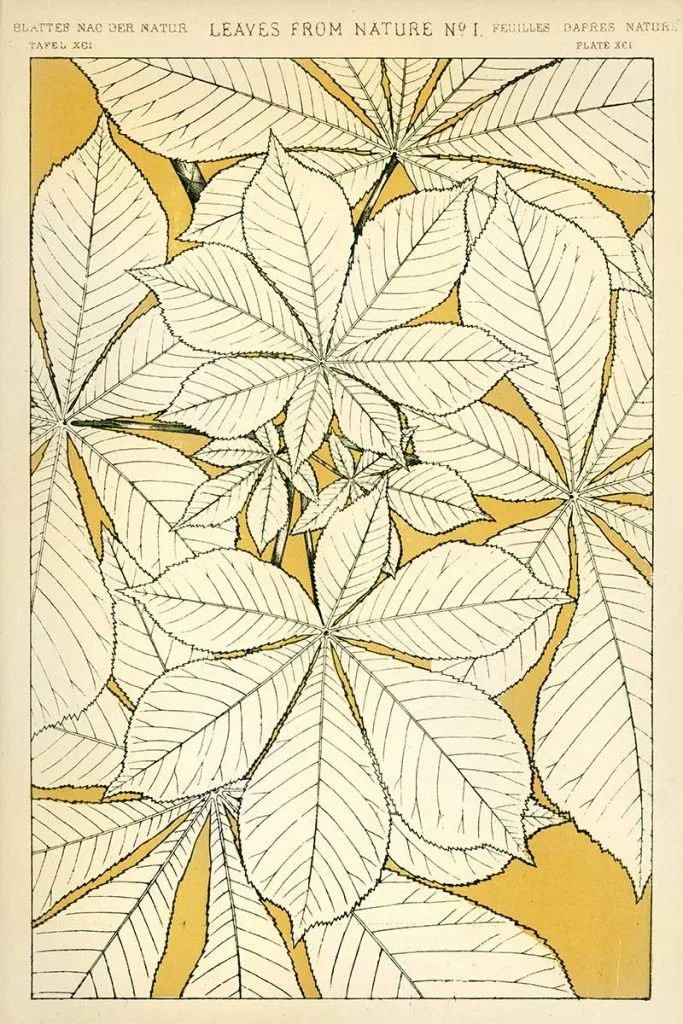
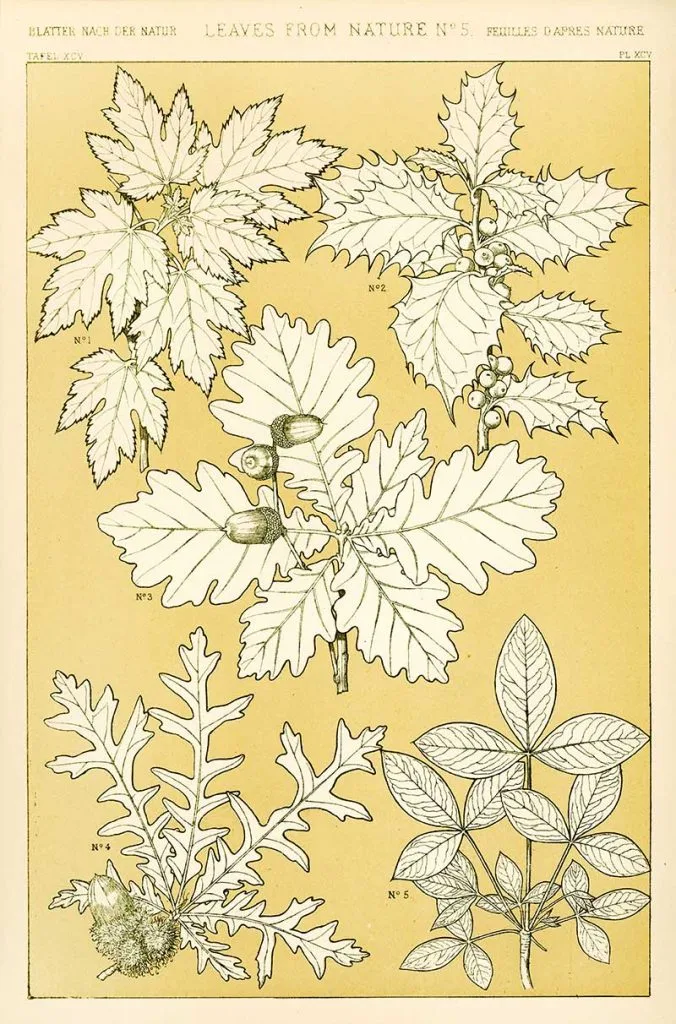
Horse-chestnut leaves, full-size traced from original leaves.
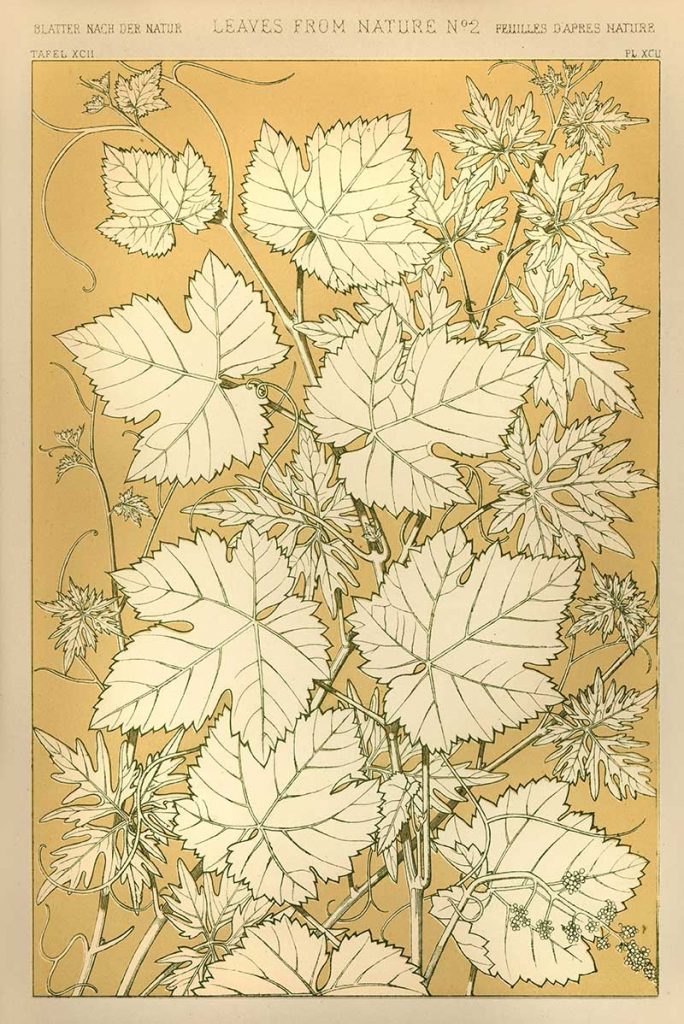
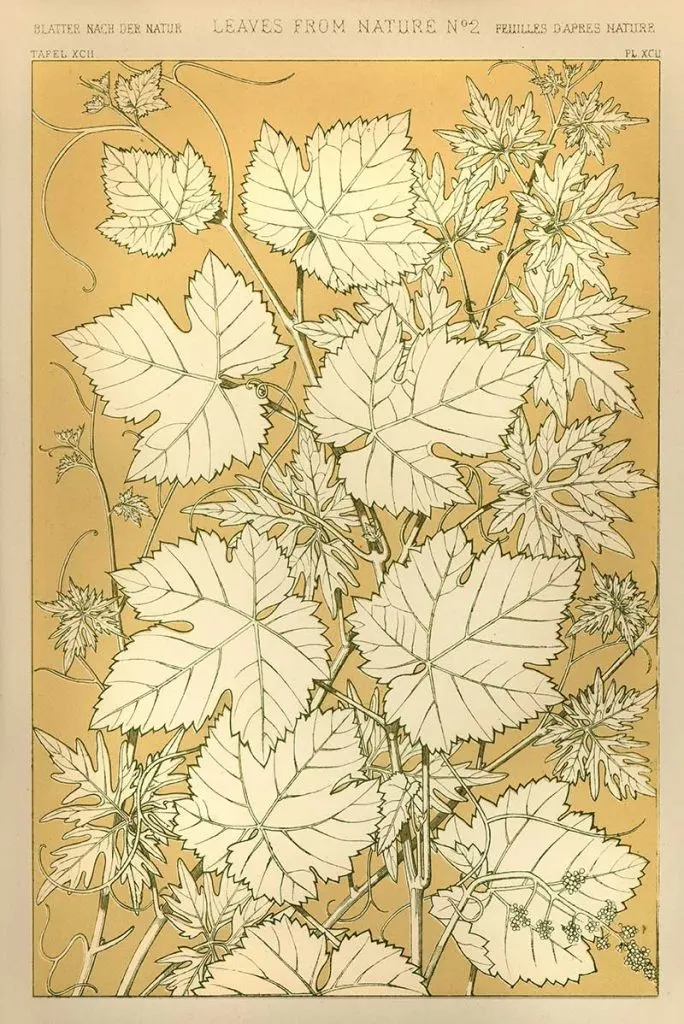
Vine leaves, full-sized, traced from natural leaves.
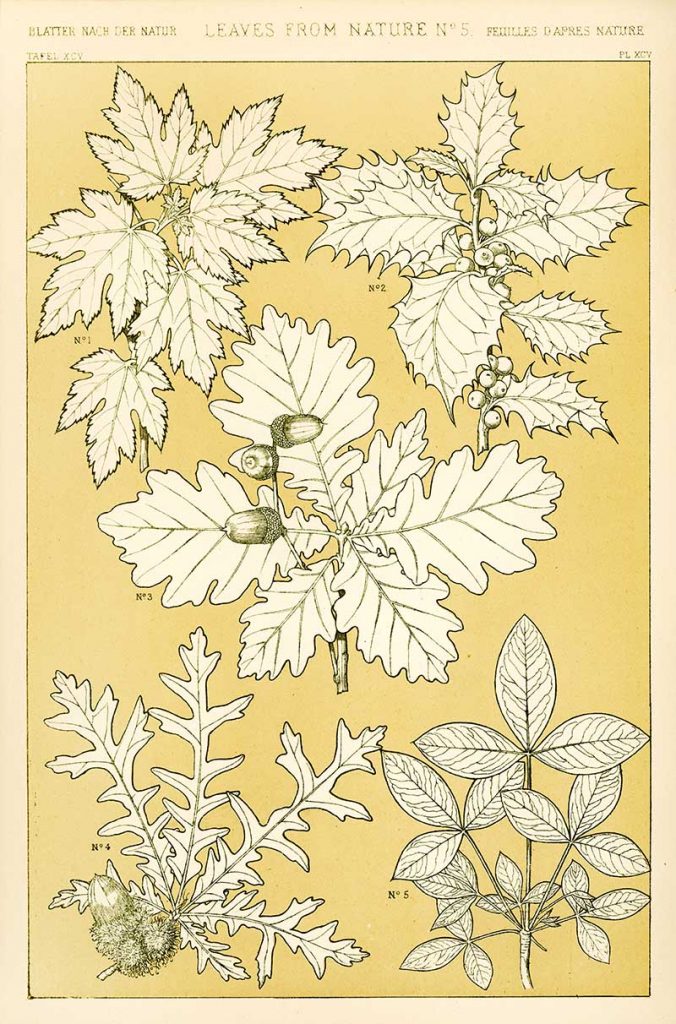
Vine, holly, oak, turkey oak, and Laburnum are all full-sized and traced from Natural Leaves.
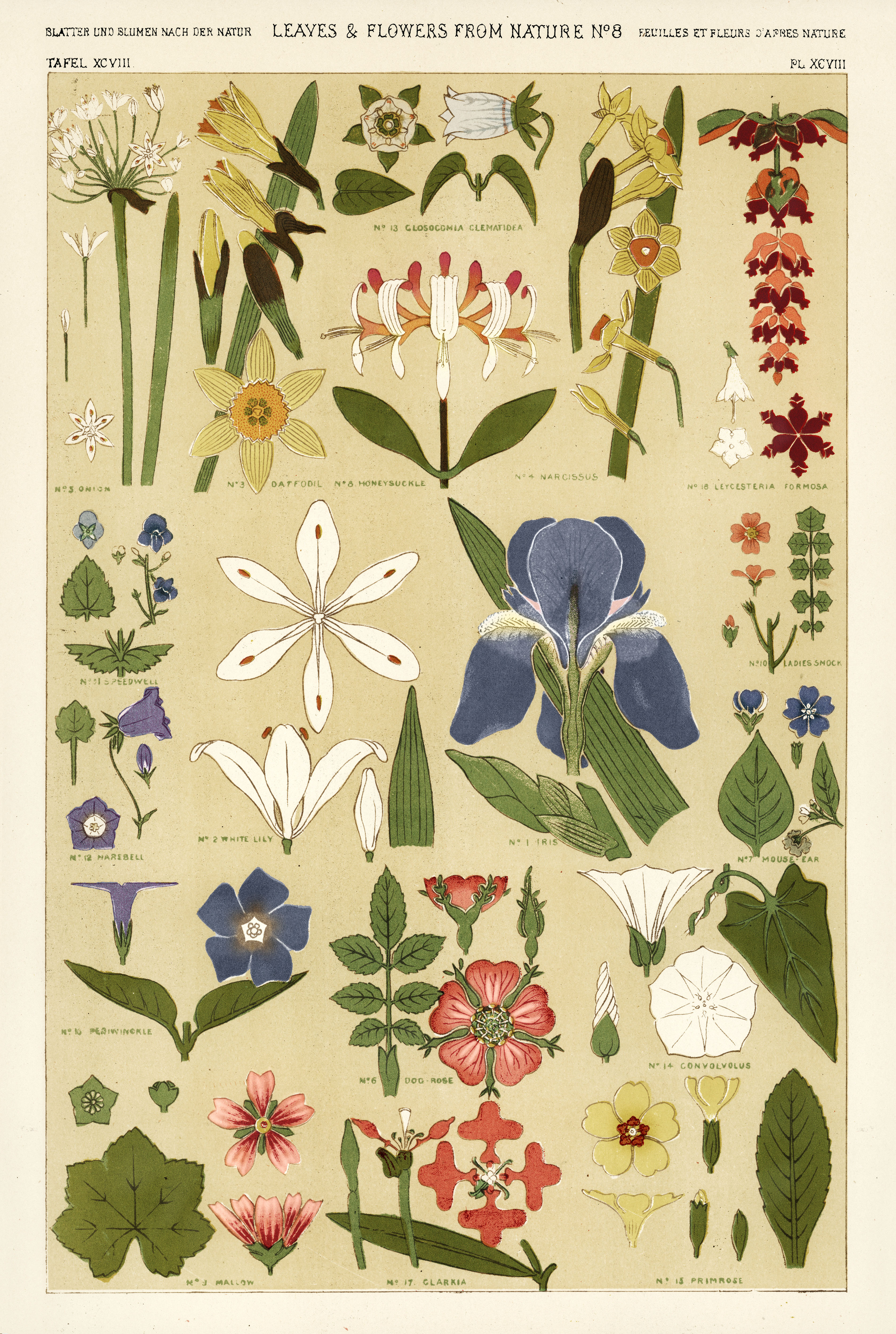
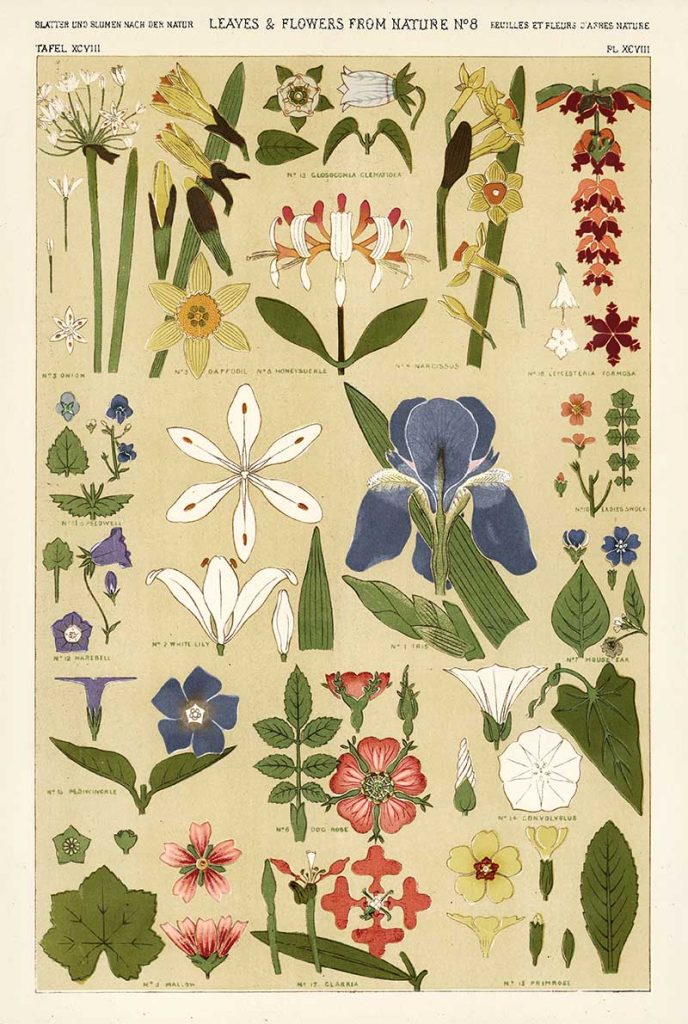
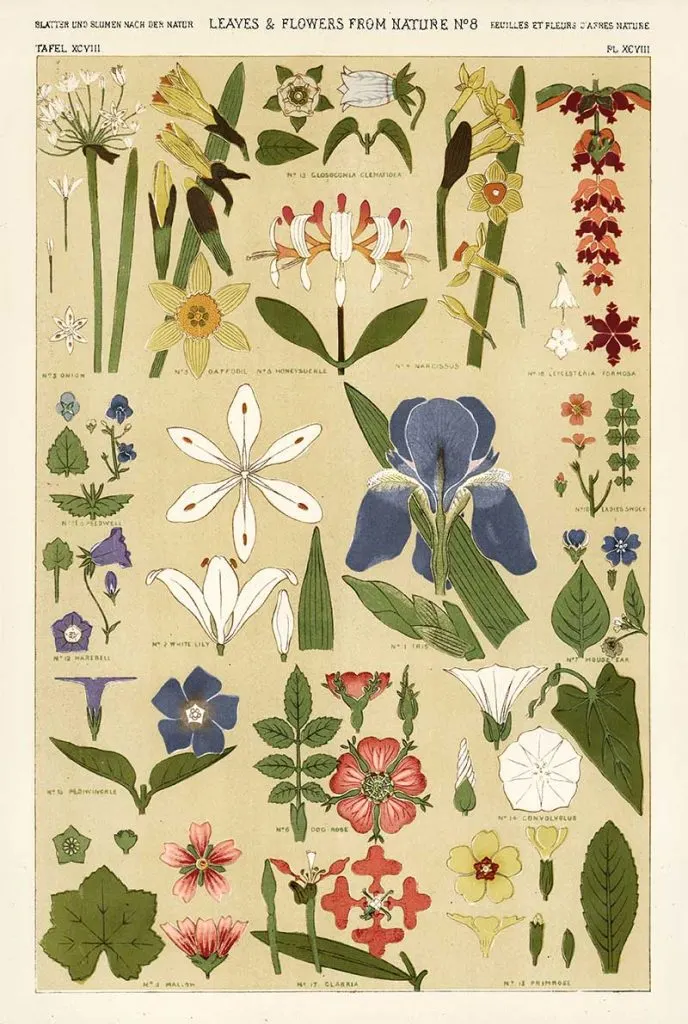
Plans and elevations of flowers, iris, white lily, daffodil, narcissus, onion, dog-rose, mouse-ear, honeysuckle, Mallow, Ladies’ smock, Speedwell, Hareball, Glossocomia clematidea, Convolvulus, Primrose, Clarkia, Leycesteria Formosa.
This plate was actually a Christopher Dresser design for the book.
The Frenchman Albert Racinet published a similar pattern book, L’ornement Polychrome, which you can see here. Some beautiful prints illustrate colour and pattern in the post about colour theory.
Another designer closely associated with the V&A museum is William Morris. You can see a collection of his beautiful interior pattern designs here.
If you enjoyed these wonderful vintage patterns and ornaments, check out Martin Gerlach’s Art Nouveau flowers and vintage plant art patterns. You might also enjoy these fabulous vintage Japanese art prints.
For textile patterns, check out these vintage floral designs. And for American ornament and design, check out the Index of American Design Prints.
Georgiana
Tuesday 5th of December 2023
These patterns are beautiful. Can they be used on end products to sell? Are they public domain CC0?
Thank you, Georgiana
claire
Tuesday 5th of December 2023
Yes, they are all in the Public Domain, so they can be used freely.
Jennie Duncan
Thursday 9th of November 2023
Very interesting collections! I've "saved" a few of these collections to my computer to use later to make decopauge tiles with. I might even try using some of them on terra cotta pots that I also craft with.
claire
Thursday 9th of November 2023
Yes there are some lovely designs perfect for decoupage!